
RNG Explained for Australia Players
When I explain RNG to Australian readers, I do not start with promises about winning, patterns or “hot” game behaviour. I start with the basic technical idea: RNG means Random Number Generator, a system designed to produce unpredictable outcomes inside digital games of chance. In plain language, it is the mechanism that decides the result of a spin, card draw, symbol arrangement or other randomised event in a casino-style environment. For Australia, however, RNG should never be explained only as a game feature. It also needs legal, safety and consumer-awareness context because many online casino-style products are restricted when provided to people physically located in Australia. The Australian Government explains that it is illegal to provide some interactive gambling activities, including online casino-style games such as roulette, poker, online pokies and blackjack, to someone in Australia.
I treat RNG as a fairness concept, but not as proof that a platform is safe, lawful or appropriate. A random number system can be technically sound while the wider service still raises legal, payment, verification, privacy or harm-minimisation concerns. That distinction is important. A game can use random outcomes, yet users still need to consider whether the service is legally available, whether identity checks are handled properly, whether payment systems are transparent and whether responsible gambling support is visible.
In my view, the biggest misunderstanding around RNG is that many people think randomness means balance. It does not. Randomness means each eligible outcome is generated according to the programmed probability model, not according to what the player expects emotionally. A losing sequence does not guarantee that a win is “due”. A previous result does not normally force the next result to compensate. This is why I avoid phrases like “the machine is ready to pay” or “the system must turn around soon”. Those phrases create false confidence and can encourage risky behaviour.
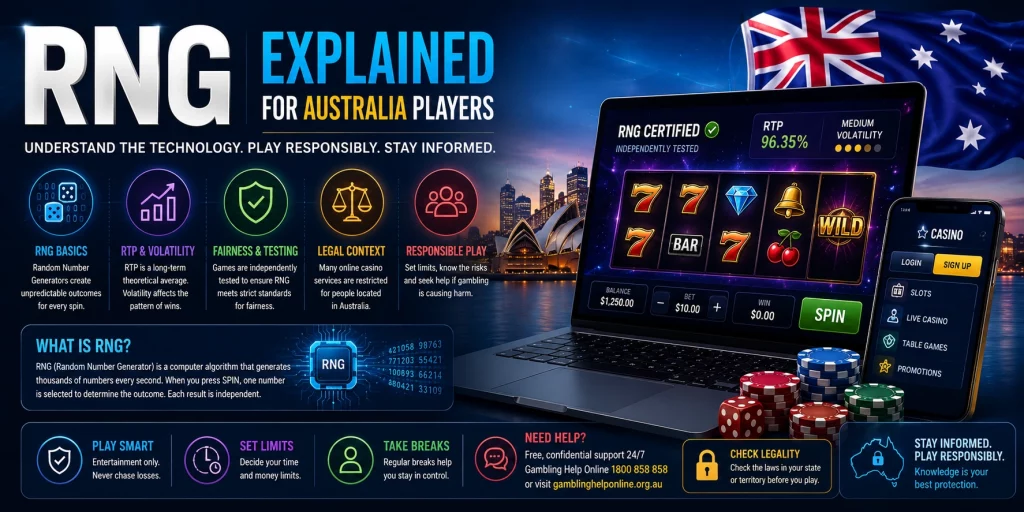
Another important point is that RNG is not the same thing as RTP. RNG is the outcome-generation mechanism. RTP, or Return to Player, is a long-term theoretical percentage based on large volumes of play. Volatility is another separate concept: it describes how results may be distributed over time, including whether wins tend to appear more frequently in smaller amounts or less frequently in larger amounts. When I write about RNG for Australian readers, I keep these three concepts separate because mixing them together leads to poor decisions and unrealistic expectations.
Why I Explain RNG Before Talking About Game Categories
I explain RNG before discussing game categories because randomisation is the core technical principle behind many casino-style products. However, I do not frame categories like Slots or Games as access points. In an Australia-focused educational article, I use those words only to explain how randomised systems may operate in theory and why legal availability should be checked through official information. ACMA states that the Interactive Gambling Act 2001 makes it illegal for gambling providers to offer some online services to people in Australia.
For example, a slot-style digital game may use RNG to select symbol positions. A digital card game may use randomisation to determine card order. A roulette-style product may use randomisation to determine a result in a digital version, while live-dealer formats may combine physical events with streaming and platform-side transaction systems. These differences matter technically, but they do not remove the legal question. Technical operation and legal permission are separate issues.
I also do not describe RNG as something a user can “read” or “beat”. A properly designed random system is not meant to reveal a pattern to the user. If someone claims that recent outcomes prove what will happen next, I treat that as a warning sign. Random systems can produce streaks, repeated losses, unexpected results and outcomes that feel emotionally unfair. That does not automatically mean the RNG is broken. It means randomness can look messy in short sessions.
This is one of the reasons I prefer a safety-first explanation. RNG should help readers understand uncertainty, not make them more confident about gambling. If a person starts looking for patterns in random outcomes, that can become risky. A responsible article should explain that RNG-based results are unpredictable and that previous outcomes should not be treated as reliable signals for future ones.
| Concept | What I mean by it | Common misunderstanding | Safer explanation for Australian readers |
| RNG | A system that produces randomised outcomes inside digital casino-style games. | Some users think RNG follows visible patterns after wins or losses. | RNG outcomes should be treated as unpredictable; previous results do not reliably predict the next result. |
| RTP | A theoretical long-term return percentage calculated across very large volumes of play. | Some users think RTP predicts what will happen in one short session. | RTP is not a short-term forecast and should not be treated as a personal result estimate. |
| Volatility | A model describing how results may be distributed over time. | Some users think high volatility means a large result is “due”. | Volatility describes risk shape, not a guarantee or timing signal. |
| Legal availability | The question of whether a service can lawfully be offered to people in Australia. | Some users assume that if a website loads, it must be legally available. | Website access and legal availability are different; official Australian sources should be checked. |
| Responsible support | Help services, self-exclusion options and harm-minimisation resources. | Some users look for support only after losses become serious. | Support should be visible early; Gambling Help Online provides free confidential help across Australia. |
How I Separate RNG From Player Control
The most important part of RNG education is explaining what the player does not control. A user can choose whether to interact with a game, but they do not control the random result. They cannot force a symbol combination, predict a random event or change the probability model by watching past outcomes. That may sound obvious, but it is one of the most common areas of confusion in casino-style content.
I also avoid language that suggests skill where skill is not the main driver. In randomised products, the outcome is driven by the system’s probability model. A user may understand the rules better over time, but understanding the rules does not convert a random game into a predictable one. That is why I would never present RNG as something that can be mastered like a puzzle.
This matters when discussing sections such as FAQ or Links. I would use a FAQ section to explain terms, risks and official Australian resources, not to answer questions like “how to win more often”. I would use a Links section to point to official regulatory and support information, not to alternative access routes, mirror pages or promotional pages. Gambling Help Online says professional counsellors are available 24/7 across Australia and describes the service as free and confidential.
RNG should also be separated from account access words such as Login and Sign up. In a safer educational context, those terms belong to account security and verification, not gambling encouragement. Since 29 September 2024, AUSTRAC says online gambling service providers must complete applicable customer identification procedures before creating an online gambling account or commencing to provide any designated service. That means account setup is not just a convenience feature; it is connected to identity, compliance and risk control.
RNG Concept Map
Why RNG Transparency Matters
I value RNG transparency because it helps readers understand what the system does and what it does not do. A clear article should explain that random outcomes are not controlled by recent results, emotions, session length or personal expectation. It should also explain that technical randomness is only one part of responsible assessment. Legal restrictions, account verification, payment safety, privacy and support visibility remain separate issues.
This is where I would also mention App and Bonus carefully. A mobile app interface may make account access easier, but it does not change how RNG works. A bonus offer may change terms or wagering conditions, but it does not make random outcomes predictable. In fact, promotional terms can sometimes make gambling harder to understand because users may confuse balance conditions, wagering requirements and real-money outcomes. In a safety-focused article, I would explain these terms only to reduce confusion, not to encourage participation.
How I Explain RNG, RTP and Volatility Without Creating False Confidence
When I explain RNG for Australian readers, I keep returning to one point: randomness is not a strategy signal. A random number generator does not remember what a user emotionally expects. It does not correct a losing session because the person feels that a better result is “due”. It does not reward longer attention, repeated attempts or a belief that the system has entered a favourable phase. A properly designed random outcome system should be treated as unpredictable from the user’s perspective.
I usually separate RNG from three ideas that are often confused with it: RTP, volatility and short-term session results. RNG is the mechanism that produces randomised outcomes. RTP is a theoretical long-term return calculation across very large volumes of activity. Volatility describes the distribution profile of results over time. A short session is only a small sample and can behave very differently from the long-term theoretical model.
This distinction matters because a lot of harmful gambling thinking begins when people turn random outcomes into personal narratives. Someone may think that a losing streak means the next result should improve. Another person may believe that a recent win proves the game is in a strong phase. Neither interpretation is reliable. Randomness can produce clusters, streaks and surprising sequences without offering any useful signal about what comes next.
In Australia, I also add legal and safety context before going deeper into technical language. ACMA explains that the Interactive Gambling Act 2001 makes it illegal for gambling providers to offer some online services to people in Australia. That means an RNG explanation should not be treated as an access guide to restricted online casino-style products. It should be a consumer-awareness explanation about probability, uncertainty and risk.
How I Separate Long-Term Maths From Short-Term Outcomes
The first mistake I try to prevent is treating long-term maths as a personal forecast. RTP is often misunderstood because it looks like a simple percentage. A person may see a theoretical return figure and assume that their own short session should roughly follow it. That is not how statistical averages work. Long-term figures are calculated across large volumes of outcomes, not one person’s brief experience.
For example, a theoretical RTP figure describes expected behaviour over a very large sample. It does not say that every user receives that percentage back. It does not promise that losses will smooth out within a session. It does not tell a person when to stop, continue or expect a result. In my writing, I explain RTP as background information only, not as a usable prediction tool.
Volatility is different again. A low-volatility product may produce more frequent smaller results in a theoretical model. A high-volatility product may produce less frequent but more variable outcomes. However, volatility is not a schedule. It does not mean that a high-volatility game must soon produce a large result because it has been quiet. It only describes the type of distribution that may appear across a large number of outcomes.
That is why I avoid any wording that implies the user can read the system. I do not write that a result is “warming up”, “cooling down” or “ready”. These phrases are misleading because they make random systems sound emotional or cyclical. A more accurate explanation is that short-term outcomes can look uneven precisely because randomness does not need to follow human expectations.
| Term | How I define it | What I avoid saying | Safer explanation |
| RNG | A technical system that produces randomised outcomes according to the game model. | I avoid saying that users can identify a reliable pattern from recent results. | RNG outcomes should be treated as unpredictable from the user’s point of view. |
| RTP | A long-term theoretical percentage calculated across very large sample sizes. | I avoid saying that RTP predicts one person’s next session or short-term result. | RTP is background maths, not a personal guarantee. |
| Volatility | A description of how outcomes may be distributed over time. | I avoid saying that volatility tells the user when a result is due. | Volatility describes risk shape, not timing. |
| Streaks | Clusters of similar outcomes that can appear naturally in random systems. | I avoid treating streaks as proof of future change. | Streaks can happen without giving a reliable prediction. |
| User control | The user may control whether to participate, but not the random outcome itself. | I avoid implying that attention, timing or persistence can control RNG output. | The safest control is deciding limits, stopping points and whether to avoid gambling altogether. |
How I Explain Random Streaks
Random streaks are one of the hardest parts to explain because they often feel meaningful. When several similar results appear close together, people naturally search for a reason. This is normal human pattern recognition. The problem is that random systems can create repeated outcomes without any hidden message. A streak can feel like evidence, but it may simply be ordinary variance.
I would explain it this way: randomness does not mean results must alternate neatly. A coin can land on the same side several times. A digital random system can produce repeated weak outcomes or several unusually strong outcomes close together. The presence of a streak does not prove that the system has changed state. It also does not prove that the next result must move in the opposite direction.
This is where gambling fallacy becomes relevant. A person may believe that if one type of result has appeared too often, the opposite result is now more likely. In independent random systems, that assumption is often false. The next result is generated according to the system’s probability model, not according to the emotional weight of previous outcomes.
In a safer Australia-focused article, I would describe streaks as a reason for caution rather than confidence. If someone starts chasing a perceived correction, that can increase harm risk. Gambling Help Online provides free support 24/7 across Australia for people affected by gambling, and this kind of support reference belongs near any discussion of chasing, streaks or loss recovery.
How I Use Account Terms in a Safer RNG Article
I use account-related terms carefully because they can easily become promotional. A section that mentions Login should focus on account security, not quick access. A section that mentions Sign up should focus on age checks, identity verification and legal availability, not convenience. AUSTRAC states that from 29 September 2024, online gambling service providers must complete applicable customer identification procedures before creating an online gambling account or providing designated services.
The same approach applies to Bonus language. I do not describe a bonus as a way to improve RNG outcomes, because it does not. A promotion may change account terms, eligible balances or wagering conditions, but it does not make random outcomes predictable. In fact, bonus conditions can make the experience more complex because users may misunderstand which funds are restricted, which rules apply and what must happen before withdrawal is possible.
I also treat an App as a technical interface, not a safer or smarter way to interact with random outcomes. A mobile interface may make account access easier, but it does not change the probability model. RNG is not affected by screen size, device type, time of day or the speed of tapping. If a page suggests that mobile use changes outcome probability, I would treat that as misleading.
This is the central rule I follow: account features, promotions and interfaces do not override randomness. They may affect access, terms, security or communication, but they do not turn random outcomes into predictable events. That is the distinction a responsible RNG article should make clear.
Why I Avoid “Winning Pattern” Language
I avoid “winning pattern” language completely because it misrepresents the technical concept. RNG-based systems are designed so that outcomes are not predictable from visible recent results. If an article says that users can identify a rhythm, timing window or sequence, it creates false confidence. That is not education; it is misleading gambling content.
I also avoid phrases that sound harmless but carry the same implication. “Watch the trend”, “wait for the right moment”, “follow the cycle” and “look for a cold game turning hot” all suggest that the user can read a random system. In a safety-focused article, I would replace those phrases with plain explanations of uncertainty.
This matters especially for young or inexperienced readers, but it also matters for adults. Random systems can be emotionally persuasive. A person may remember near-misses more strongly than ordinary losses. They may treat small wins as proof that a bigger result is close. They may keep going because the previous outcome felt almost successful. A responsible article should not reinforce those interpretations.
Instead, I would write that RNG is designed to make each eligible outcome uncertain. The user should not expect personal timing, emotional persistence or recent results to change the probability model. If gambling begins to feel urgent, stressful or financially uncomfortable, the safer response is to stop and use support resources rather than continue trying to solve the pattern.
How I Explain RNG Testing, Fairness Claims and Player Misunderstanding
When I write about RNG for Australia players, I do not treat “fairness” as a marketing word. I treat it as something that has to be explained carefully. A platform may say that outcomes are random, but that statement alone is not enough to help readers understand what randomised fairness means. Randomness does not mean that every short session feels fair. It does not mean outcomes alternate neatly. It does not mean the system compensates the user after a difficult sequence. It only means that results are generated according to the game’s probability structure without the user being able to predict the next result from recent outcomes.
This is why I separate fairness claims from outcome expectations. A technically random system can still produce results that feel harsh, repetitive or emotionally frustrating. That does not automatically prove that the system is broken. Random systems can produce clusters and streaks because randomness is not designed to satisfy human expectations. The more important question is whether the game model is independently tested, whether the platform explains probability concepts honestly and whether the content avoids suggesting that users can “read” the RNG.
For Australian readers, I would also keep the legal context visible. ACMA explains that the Interactive Gambling Act makes it illegal for gambling providers to offer some online services to people in Australia, and its enforcement pages describe prohibited interactive gambling services with an Australian customer link. That means RNG education should remain informational and consumer-awareness focused, not a guide to accessing restricted products.
I also avoid writing that RNG makes gambling safe. It does not. RNG may be part of technical fairness, but gambling risk still exists. A person can lose money in a random system even when the system operates as designed. Randomness can actually increase risk when someone misunderstands it, because the user may keep looking for meaning in outcomes that are not meant to be predictable.
How I Interpret RNG Testing
RNG testing is often described too vaguely. I prefer to explain it as a technical review process that may examine whether the randomisation mechanism behaves according to the intended mathematical model. Testing may look at output distribution, statistical behaviour, software implementation and whether results are consistent with the approved design. The purpose is not to guarantee that a user wins. The purpose is to assess whether the system produces outcomes according to its stated rules.
The key misunderstanding is that testing does not remove variance. A tested RNG can still produce long losing streaks, repeated near-misses or unusual-looking short-term results. Testing does not make outcomes comfortable. It only supports the claim that the outcome-generation system behaves within expected statistical parameters over large samples.
I also explain that users usually cannot verify technical testing from the game screen alone. A logo, certificate claim or provider name may be visible, but proper confidence depends on transparent, verifiable information from credible testing bodies, regulatory context and platform documentation. A page should not ask readers to trust a vague fairness badge without explaining what fairness actually means.
Another point I include is that fairness testing and legal availability are different questions. A game can be technically tested and still not be legally available in a specific jurisdiction. This matters for Australia because legal restrictions cannot be solved by saying that the RNG is certified. Technical design does not override the Interactive Gambling Act.
| Fairness area | What I explain | Common misunderstanding | More accurate wording |
| RNG testing | I explain it as a technical review of whether randomisation behaves according to the intended model. | Some users think testing means outcomes will feel balanced in short sessions. | Testing supports system integrity; it does not guarantee comfortable or profitable results. |
| Fairness certificate | I treat certificate claims as signals that need context, not automatic proof of full platform safety. | Some users assume a fairness logo means every part of the platform is trustworthy. | A fairness claim may relate to game mechanics, while payments, privacy and legal availability remain separate issues. |
| Near-miss outcomes | I explain that near-misses can feel meaningful even when they do not predict future results. | Some users think a near-miss means the next result is closer to a win. | A near-miss is still a non-winning outcome and should not be treated as a signal. |
| Short-session variance | I explain that small samples can differ sharply from long-term mathematical averages. | Some users expect the game to correct itself within a short period. | Short-term results can remain uneven for longer than expected. |
| Legal context | I explain that technical fairness and Australian legal availability are separate topics. | Some users assume a tested game is automatically lawful to access. | Technical testing does not replace official legal and regulatory review. |
Why I Discuss Near-Misses Carefully
Near-misses require careful language because they can strongly affect perception. A near-miss is an outcome that looks close to a desired result but is still not that result. In casino-style games, users may remember near-misses more vividly than ordinary losses because the result feels emotionally close. That feeling can create a false sense of progress.
I never describe a near-miss as evidence that the RNG is moving toward a better outcome. A random system does not normally operate like a staircase where each close result brings the user nearer to a win. The next event is generated according to the game model, not according to how close the previous result felt.
This is important because near-misses can encourage chasing behaviour. A user may think, “It almost happened, so I should continue.” That interpretation is risky. A safer explanation is that a near-miss remains a loss or non-winning result, and it should not be treated as a reliable indicator of what comes next.
For Australian readers, I would connect this section to harm awareness. Gambling Help Online provides free, confidential counselling support across Australia, including 24/7 online chat and phone help. That kind of resource is relevant whenever a discussion touches on chasing, frustration or repeated attempts after losses.
How I Explain “Provably Fair” Claims
Some online gambling content uses the phrase “provably fair”, especially around crypto-style gambling products. I handle that phrase cautiously. In a technical sense, it can refer to systems where cryptographic methods are used to let users verify that a result was not changed after a commitment was made. However, this does not mean the product is safe, legal, harmless or suitable.
I would not let “provably fair” become a trust shortcut. A provably fair mechanism may address one narrow question about result manipulation, but it does not answer wider questions about legal availability, age controls, identity verification, payment protection, dispute handling, privacy, gambling harm or operator accountability. A page that treats provably fair as a complete safety guarantee is misleading.
For Australia, I would be especially careful because product legality remains separate from the technical fairness model. A crypto or offshore platform may use technical fairness language while still raising serious regulatory and consumer-protection concerns. ACMA has continued to warn and act against illegal online gambling and affiliate marketing websites, including services found to breach the Interactive Gambling Act.
My wording would be: cryptographic fairness claims may explain one technical mechanism, but they do not replace licensing review, legal compliance, consumer protection, identity rules or harm-minimisation safeguards. That sentence keeps the concept accurate without turning it into a promotional argument.
Why RNG Does Not Remove Gambling Harm
A core point in this article is that RNG fairness does not remove gambling harm. A random system can be fair in the technical sense and still expose users to financial loss, stress, chasing behaviour and distorted expectations. Fairness does not mean favourable. Randomness does not mean balanced in the short term. A game can operate correctly and still produce outcomes that are harmful for the person interacting with it.
I explain this because many people confuse “not rigged” with “safe”. Those are not the same. A game can be non-rigged and still risky. A product can be random and still designed around negative expected value. A platform can display technical claims and still leave users confused about payments, account restrictions or legal availability.
For Australia-focused content, I would keep a harm-minimisation paragraph close to every technical explanation. If a person feels pressure to recover losses, continue after frustration, increase spending or hide gambling behaviour, the issue is no longer technical curiosity. It is a support issue. Gambling Help Online states that support is available 24/7 and is free, professional and confidential.
This framing makes the RNG article more responsible. It teaches readers that understanding randomness should reduce false confidence, not increase participation. The goal is to make uncertainty clearer.
My Final View of RNG, Player Protection and Australian Context
When I finish an RNG explanation for Australian readers, I do not end with game mechanics. I end with interpretation. RNG is a technical system, but the way people interpret it can affect real decisions. If a person understands RNG correctly, they are less likely to believe in streaks, timing tricks, personal luck cycles or hidden winning patterns. If they misunderstand it, they may treat randomness as something they can solve, and that can lead to chasing, overspending and stronger emotional pressure.
My final position is simple: RNG should reduce false confidence, not increase it. A random number generator does not make outcomes controllable. It does not make short-term results predictable. It does not turn RTP into a personal forecast. It does not remove the risk of loss. It also does not answer the legal question of whether a casino-style service can be provided to someone in Australia. ACMA explains that the Interactive Gambling Act makes it illegal for gambling providers to offer some online services to people in Australia, and ACMA’s enforcement material refers to prohibited interactive gambling services with an Australian-customer link.
That legal context is why I would keep this article informational from beginning to end. A technical explanation of RNG is useful because it helps readers understand uncertainty, but it should not become a guide to participation. Australia’s rules, identity obligations, consumer protections and gambling-harm support resources all matter alongside the maths. AUSTRAC states that from 29 September 2024, online gambling service providers must complete applicable customer identification procedures before creating an online gambling account or providing designated services to an individual customer.
How I Explain RNG in a Final Practical Framework
My practical framework has five parts. First, I treat RNG as a randomisation mechanism, not a prediction tool. Second, I treat RTP as long-term statistical context, not a session forecast. Third, I treat volatility as risk-shape information, not a timing signal. Fourth, I treat fairness claims as limited technical signals, not full proof of platform safety. Fifth, I treat Australian legal and support resources as essential context, not footnotes.
This framework helps avoid the most common errors. A user who understands RNG should not expect a losing sequence to self-correct. A user who understands RTP should not expect a short session to follow a theoretical percentage. A user who understands volatility should not interpret silence, weak results or near-misses as proof that a large result is close. A user who understands fairness testing should still ask separate questions about legality, payment handling, privacy and support.
I also make one point very direct: random does not mean harmless. A randomised system can operate exactly as designed and still create financial loss, stress or harmful patterns of behaviour. That is why technical literacy should be paired with harm-minimisation awareness. BetStop is Australia’s National Self-Exclusion Register, a free government initiative that can block a registered person from licensed Australian online and phone gambling providers, including account opening and marketing messages.
| Final RNG principle | How I explain it | Misleading interpretation to avoid | Safer reader takeaway |
| RNG creates uncertainty | I describe RNG as a technical system for generating unpredictable outcomes. | The next result can be predicted from recent results. | Recent outcomes should not be treated as reliable signals. |
| RTP is long-term maths | I explain RTP as a theoretical average calculated across large volumes of outcomes. | A short session should return something close to the RTP figure. | Short-term results can differ sharply from theoretical averages. |
| Volatility is not a schedule | I describe volatility as the distribution shape of outcomes over time. | A high-volatility product is “due” after quiet results. | Volatility does not tell anyone when an outcome will occur. |
| Fairness is limited in scope | I treat RNG testing or fairness claims as technical indicators only. | A tested game automatically means the whole platform is safe or lawful. | Legal availability, payments, privacy and support remain separate issues. |
| Support matters early | I include help resources before gambling behaviour becomes severe. | Support is only needed after major harm has already occurred. | Free and confidential Australian support can be used at any stage of concern. |
RNG Understanding and Risk Awareness
Why I Treat Support Resources as Part of RNG Education
I include support resources in an RNG article because misunderstanding randomness can affect behaviour. If a person believes a result is due, they may continue longer than planned. If they believe a near-miss means progress, they may keep spending. If they believe RTP must correct a losing session, they may chase losses. These are not purely mathematical mistakes. They can become financial and emotional risks.
Gambling Help Online states that free support is available 24/7 across Australia for anyone affected by gambling, and its immediate-help page refers to free confidential helpline and chat support. I would include this near the end of the article because technical understanding should lead to safer decisions, not stronger confidence in random outcomes.
I also mention self-exclusion carefully. BetStop is designed to block registered people from licensed Australian online and phone gambling providers; once registered, providers cannot let the person place bets, open new betting accounts or send marketing messages. In an RNG article, this is relevant because some readers may realise that randomness is not something they can control and may prefer to step away from gambling environments entirely.
This is the safest way to close the topic. RNG knowledge is not a tool for better gambling. It is a tool for understanding why outcomes cannot be controlled. If that understanding makes gambling feel less appealing or less manageable, support resources are a practical next step.
My Closing Summary for Australian Readers
My final explanation of RNG is deliberately restrained. RNG is a technical process that generates uncertain outcomes. RTP provides long-term mathematical context. Volatility describes distribution style. Fairness testing may support technical integrity, but it does not guarantee favourable results, short-term balance, legal availability or platform-wide safety.
For Australian readers, the wider context is essential. Online casino-style services may be restricted under Australian law, customer identification obligations apply to online gambling service providers, and gambling-harm support is available through national resources. ACMA, AUSTRAC, BetStop and Gambling Help Online each address different parts of this environment: legality, identity checks, self-exclusion and support.






Comments