
Volatility Explained Australia Players
Volatility Explained for Australian Players at Leon Casino
Volatility is one of the most important ideas Australian players should understand before choosing an online casino game. It does not tell you whether a game is “good” or “bad”, and it does not guarantee a win. Instead, volatility explains how a game usually behaves over time. Some games pay smaller wins more often. Others stay quiet for longer, then occasionally deliver larger results. For Leon Casino players, this difference matters because it affects bankroll planning, session length, bonus use, and general expectations.
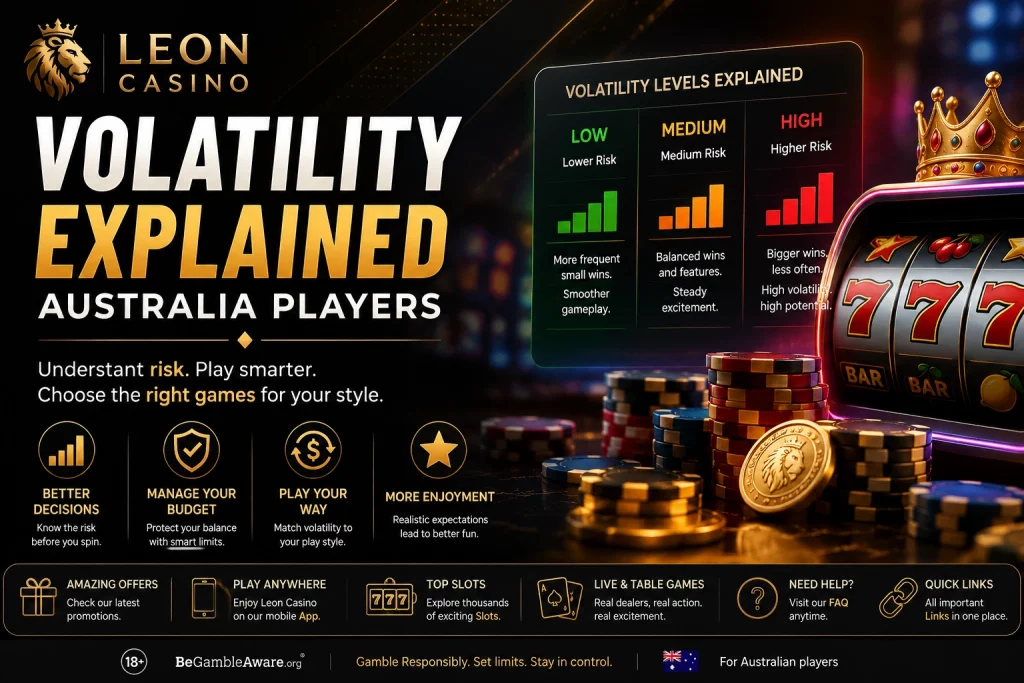
In simple terms, low-volatility games are usually smoother. They may give regular small returns, which can make a session feel more stable. High-volatility games are more uneven. They can produce long dry periods, but they may also offer bigger win potential when the right feature, bonus round, or symbol combination lands. Medium-volatility games sit between those two extremes, offering a more balanced rhythm.
For Australian players, volatility is especially relevant when comparing pokies, table games, live casino titles, and promotional offers. A player who wants longer entertainment from a modest deposit may prefer lower or medium volatility. A player who accepts more risk for higher potential payouts may lean toward higher volatility. Neither choice is automatically better. The correct approach depends on budget, patience, and the reason for playing.
Before starting a session, it is useful to check the game information screen where available. Many providers display volatility, hit frequency, RTP, paylines, max win, and bonus feature details. RTP shows the theoretical return over a very long period, while volatility describes the pattern of that return. A game can have a solid RTP and still feel difficult in short sessions if its volatility is high.
Players who access Leon Casino through the Login page should not choose games only by theme or graphics. A colourful pokie may look casual, but its math model can still be aggressive. The best habit is to treat volatility as part of the game profile, just like stake size, paylines, and feature-buy options.
Why Volatility Matters More Than Many Players Expect
Many beginners focus on RTP because it looks like the most mathematical and reliable number. RTP is useful, but it does not explain how a game feels during actual play. A pokie with 96% RTP may return value in very different ways depending on its volatility. One version may give frequent small wins, while another may collect many losing spins before triggering a meaningful feature.
This is why two games with similar RTP can create completely different experiences. In a low-volatility game, the balance may move slowly. The player often sees small returns, even if the final session still ends below the starting amount. In a high-volatility game, the balance can drop quickly before any major feature appears. This does not mean the game is broken. It means the game is designed around wider result swings.
For Leon Casino players, understanding this helps avoid the common mistake of judging a game too quickly. A high-volatility pokie can feel “cold” after 50 or 100 spins, but that short sample says little about the long-term math. At the same time, chasing a feature because “it must be due” is not a reliable strategy. Each spin remains independent when the game uses a properly certified random number generator.
Volatility also affects how bonuses should be used. A bonus balance may look larger than a cash deposit, but wagering requirements can make high-volatility choices risky. If the bonus rules allow many different games, lower or medium-volatility titles may support more consistent wagering progress. High-volatility games can still be attractive, but they may drain bonus funds before the wagering target is reached.
That is why players reviewing the Bonus section should look beyond the headline amount. Wagering rules, max bet limits, game contribution rates, expiry periods, and volatility all interact. A bonus that looks generous can become difficult to use if the player chooses games with unsuitable risk patterns.
Volatility and Bankroll Planning
Bankroll planning is where volatility becomes practical. A player using a small deposit on high-volatility pokies may experience very short sessions if the stake size is too large. The same deposit can last much longer on low-volatility games or when the bet size is reduced. The goal is not to remove risk, because gambling always includes risk. The goal is to make the session fit the budget.
A simple method is to decide the session budget first, then choose games and stakes around that amount. For example, a player with a limited budget may divide it into many smaller spins instead of using large bets immediately. This gives the game more time to show its normal rhythm. It does not guarantee better results, but it reduces the chance of ending the session after only a few minutes.
High-volatility games need especially careful stake control. If the player wants to test a game with wide swings, smaller bets make more sense than aggressive staking. The potential payout will be smaller, but the session becomes easier to manage. Players who increase bets after losses often create unnecessary pressure, especially on games that are designed to have long quiet periods.
Volatility also helps explain why emotional decisions are dangerous. A player may move from one game to another too quickly, increase the stake after a losing run, or continue playing beyond the original limit because a bonus feature feels close. These reactions are common, but they are not based on the mathematics of the game. A better approach is to set a fixed limit before playing and stop when that limit is reached.
Practical Example of Volatility in Real Play
Imagine two Australian players starting with the same balance. The first chooses a low-volatility pokie and uses small stakes. The session may include frequent minor wins, enough to slow down balance loss and create a longer playing period. The second chooses a high-volatility pokie with the same stake. This session may feel more intense because wins are less frequent, and the balance can move down faster.
Neither player has made a “wrong” choice. They have chosen different risk profiles. The first player values time and balance stability. The second player accepts sharper swings for the possibility of a stronger feature result. Problems appear only when the player does not understand the difference before starting.
This is why volatility should be treated as a basic part of game selection at Leon Casino. It helps players match games with their own budget and expectations. It also reduces frustration because the player knows what kind of experience the game is likely to produce.
How Volatility Changes the Way Australian Players Experience Games
Volatility is not only a technical label. It changes the emotional rhythm of a session. A low-volatility game often feels more active because small wins appear regularly. The player sees movement on the balance, hears win sounds, and may feel that the game is giving something back. However, these smaller wins do not necessarily mean profit. They may simply slow the rate of loss or extend the entertainment time.
High-volatility games feel different. They can be quieter for long periods, with fewer small wins and more empty spins. When a bonus round or major feature finally appears, the result may be stronger, but the waiting period can be demanding. This is why high-volatility pokies are often exciting for experienced players but frustrating for players who expect frequent action.
At Leon Casino, Australian players should think about volatility before choosing between pokies, table games, live casino titles, and feature-heavy releases. A player who joins through the Sign up page and starts with a fresh account may be tempted to test the most visually dramatic games first. That is understandable, but it is better to check the game’s risk profile before increasing stakes.
The same applies to mobile play. When using the App or mobile version, games can feel faster because navigation is smoother and spins are easier to repeat. This makes stake discipline even more important. Volatility does not become safer because the screen is smaller or the session feels casual. The same mathematical structure remains behind every spin.
| Player Goal | Suitable Volatility | Reason | Practical Approach |
| Longer entertainment from a fixed budget | Low to medium | Smaller, more frequent returns can help extend the session. | Use modest stakes and avoid fast bet increases. |
| Balanced gameplay with some stronger win potential | Medium | The game may offer both regular base-game wins and occasional features. | Set a session limit and choose games with clear information panels. |
| Large feature potential | High | Wins may be less frequent, but bonus rounds can carry stronger outcomes. | Reduce stake size and expect longer dry periods. |
| Bonus wagering progress | Low to medium | Extreme swings may drain bonus funds before wagering is completed. | Check contribution rates, max bet rules, and expiry terms first. |
Low, Medium, and High Volatility in Practice
Low-volatility games are often suitable for players who want a calmer rhythm. These games may not produce dramatic payouts often, but they usually give more frequent small wins. For Australian players who play mainly for entertainment, this can be useful. It keeps the session moving and reduces the pressure created by long losing streaks.
Medium-volatility games are often the most comfortable middle ground. They may still include bonus features, multipliers, free spins, and themed mechanics, but the balance movement is not usually as sharp as in high-volatility games. Many players prefer this category because it offers excitement without making the session feel too unstable.
High-volatility games are usually built around stronger payout potential. They may include expanding wilds, cascading reels, high multipliers, jackpot features, or bonus rounds that can change the entire result of a session. The trade-off is that these games may produce many ordinary or losing spins before something meaningful happens.
This difference is easier to understand when shown visually:
The chart is not a promise of exact results. It is a practical illustration of how session swings usually increase as volatility rises. Low volatility does not remove risk, but it may soften the rhythm. High volatility does not guarantee large wins, but it usually increases the range between quiet periods and stronger outcomes.
Volatility and RTP: Why They Are Not the Same
RTP and volatility are often confused, but they describe different things. RTP stands for return to player. It is a long-term theoretical percentage calculated across a very large number of rounds. Volatility describes how uneven or stable the results are along the way. A game with 96% RTP can still feel harsh if it is highly volatile.
For example, two games may both advertise a similar RTP, but one may return many small wins while the other saves most of its value for rare bonus features. In the first game, the player may feel more activity. In the second game, the player may experience deeper balance drops before a meaningful win arrives. The RTP figure alone does not explain this difference.
Australian players should therefore avoid choosing games only because the RTP looks acceptable. RTP is useful, but it should be read together with volatility, max win, feature frequency, and stake size. A high-RTP game can still be unsuitable for a short session if the volatility is too sharp. A slightly lower-RTP game may feel more controlled if the win distribution is smoother.
This is especially important when playing feature-heavy pokies. Modern games often advertise large multipliers, expanding mechanics, jackpots, and bonus-buy options. These features may look attractive, but they often come with higher volatility. The bigger the advertised potential, the more important it becomes to understand how rarely that potential may appear.
Reliable Sources for Understanding Game Risk
Players who want a more informed view can compare casino game information with independent education resources. These sources do not predict outcomes, but they help explain gambling risk, probability, and safer gambling habits.
Volatility becomes easier to manage when players combine game information with safer gambling habits. The goal is not to calculate a perfect outcome. That is impossible in random games. The goal is to understand the type of session a game is likely to create and to decide whether that session fits the player’s budget.
Common Mistakes Australian Players Make with Volatility
One common mistake is assuming that frequent small wins mean a game is profitable. Low-volatility games can create that impression because they return small amounts often. However, if the total stake is higher than the total return, the session can still end in a loss. The frequent wins only change the rhythm, not the basic risk.
Another mistake is believing that high-volatility games are “better” because they offer larger potential wins. Larger potential usually comes with larger variance. This means the player may need more balance, more patience, and stronger limits. Without those controls, high-volatility games can shorten a session quickly.
A third mistake is changing stakes too aggressively. If a player loses several spins on a high-volatility game, increasing the bet does not make the bonus round more likely. It only increases exposure. A more disciplined approach is to decide the stake before the session begins and avoid emotional changes.
Finally, some players move from game to game too quickly. They may assume that a game is “not paying” after a short run. In reality, short sessions do not reveal much about the long-term structure. It is better to select games based on volatility, RTP, and personal limits than to react to every short-term result.
Choosing Leon Casino Games by Volatility Level
Choosing games by volatility is more practical than choosing only by theme. A pokie can have an attractive design, familiar symbols, smooth animations, and a strong sound profile, but none of that explains how the balance may move during play. For Australian players at Leon Casino, the better approach is to read the game as a full risk profile. Volatility, RTP, stake range, max win, bonus mechanics, and wagering contribution all need to work together.
Low-volatility games are often suitable when the main goal is controlled entertainment. They may not create dramatic spikes, but they can keep the session active. Medium-volatility games are useful when a player wants a mix of regular play and occasional stronger features. High-volatility games should be approached with more caution, especially when the player has a limited budget or is using bonus funds.
The Slots section is where volatility becomes especially visible. Many modern online slots are built around bonus rounds, multipliers, expanding reels, respins, jackpots, or cascading win systems. These features can make a game look generous, but they may also increase variance. A game that advertises a large maximum win usually needs a wider mathematical spread to support that potential.
Players should also remember that volatility is not a prediction tool. It does not say that a feature will land soon, and it does not identify a “hot” or “cold” game. It only describes the usual distribution of outcomes over time. This is why responsible players use volatility to shape stake size and session limits, not to chase specific results.
| Game Category | Typical Volatility Pattern | What Australian Players Should Check | Leon Casino Session Tip |
| Classic-style pokies | Often low to medium, depending on paylines and bonus structure. | Paytable, line wins, stake range, and whether features are simple or complex. | Useful for players who want a more stable rhythm and longer play from a fixed budget. |
| Feature-heavy video slots | Usually medium to high, especially with multipliers or cascading mechanics. | Bonus frequency, max win, volatility label, and feature rules. | Start with smaller bets until the game’s rhythm becomes clear. |
| Jackpot-style games | Often high because part of the appeal is linked to larger prize potential. | Contribution rules, jackpot trigger conditions, and base-game return. | Avoid treating jackpot potential as a likely session outcome. |
| Table games | Usually depends on rules, bet type, and player decisions. | House edge, side bets, table limits, and payout rules. | Stick to simple bets before adding higher-risk side options. |
| Live casino games | Can range from controlled to highly volatile, depending on the format. | Game type, multiplier mechanics, bet limits, and round speed. | Set limits before entering because live rounds can feel faster and more immersive. |
Volatility and Bonus Wagering
Bonus wagering changes how volatility should be interpreted. A player using cash can stop, change stakes, or switch games freely. A player using bonus funds must usually deal with wagering requirements, max bet rules, contribution percentages, restricted games, and expiry periods. This makes game choice more important.
Low and medium-volatility games can support more consistent wagering progress because the balance may move less sharply. This does not mean the player will complete wagering successfully. It simply means the session may be less exposed to sudden balance drops. High-volatility games can still be allowed under some bonus rules, but they may create a higher chance of losing the bonus balance before enough wagering has been completed.
At Leon Casino, players should read bonus terms before selecting games. Some games may contribute less than 100% toward wagering. Some table games may contribute very little or be excluded entirely. Some high-risk features may be restricted. If a player ignores these rules, the bonus may become harder to use or even invalidated.
The safest practical habit is to match the bonus with the correct volatility level. A player who wants to work through wagering should usually avoid extreme volatility unless the terms are clear and the budget can handle the swings. It is better to make steady progress than to rely on one rare feature win.
Reading Game Information Before You Play
Most players do not spend enough time reading the game information panel. This is where the important details usually sit: RTP, paylines, symbols, bonus triggers, feature rules, max win, and sometimes volatility. The information panel may not always give every answer, but it provides more guidance than the theme alone.
When a game does display volatility, players should use it as a planning signal. If the game is low volatility, smaller wins may appear more often, but large payouts may be limited. If the game is medium volatility, the experience may be balanced. If the game is high volatility, the player should expect fewer meaningful hits and larger session swings.
The Games page can also help players compare categories rather than treating every title the same. Pokies, live games, blackjack, roulette, baccarat, crash-style titles, and game-show formats do not behave identically. Even inside one category, risk can change sharply. A standard roulette bet is different from a multi-number risky layout. A simple blackjack hand is different from a side bet. A basic slot is different from a high-multiplier cascading pokie.
Good game selection starts before the first spin or round. It means asking simple questions: How much am I willing to risk? How long do I want the session to last? Am I using bonus funds or cash? Does this game have frequent small wins or rare larger features? Can I accept losing the session budget without chasing?
Why High Volatility Feels Attractive
High-volatility games are popular because they offer intensity. They often include dramatic bonus rounds, large multipliers, expanding mechanics, jackpot symbols, or advertised max-win figures. These features create anticipation. Even when the base game is quiet, the possibility of a strong feature keeps the session emotionally engaging.
However, this attraction is also the main risk. The player may continue because the feature feels close, even though random games do not work that way. A high-volatility game can go through long quiet periods without any obligation to produce a bonus. Past losses do not make a future feature more likely.
Australian players should be especially careful with games that combine fast spin speeds with high volatility. Fast rounds can make losses feel smaller at first because each individual stake may look modest. But repeated spins can add up quickly. The faster the game, the more important it becomes to slow down and check the balance regularly.
A useful rule is to decide in advance how many spins or how much balance will be used before reassessing. This creates a pause point. Without pause points, a high-volatility session can turn into automatic play, where decisions are made by emotion rather than planning.
Responsible Volatility Management
Responsible volatility management does not mean avoiding all risky games. It means understanding what kind of risk is being accepted. A player can enjoy high-volatility pokies if the stake is controlled, the budget is fixed, and the expectations are realistic. Problems usually start when volatility is misunderstood.
One effective approach is to separate entertainment funds from essential money. A casino session should never depend on money needed for bills, rent, food, transport, or savings. Once the entertainment budget is set, volatility helps decide how that budget should be used. Low-volatility games may allow more rounds. High-volatility games require smaller stakes or shorter sessions.
Another practical step is to avoid chasing losses. If a high-volatility game has not produced a feature, that does not mean the next spin is more likely to do so. Random outcomes remain independent. The best decision is usually to stop at the planned limit, not to continue because the session feels unfinished.
Players who are unsure about rules, wagering terms, or account limits should check the FAQ section before playing further. Clear information is part of safer play. When players understand how volatility, bonus rules, and limits work together, they are less likely to make rushed decisions.
Volatility as Part of a Complete Game Strategy
Volatility should not be treated as the only factor in game choice. It works best when combined with RTP, stake size, session length, and personal comfort level. A player who dislikes long dry periods may not enjoy high-volatility games, even if the max win looks attractive. A player who wants stronger feature potential may find low-volatility games too flat.
The best game strategy is therefore personal. It does not copy another player’s preference. It starts with the player’s own budget and patience. Someone who wants a quiet session after work may prefer low or medium volatility. Someone who enjoys more dramatic swings may choose higher volatility, but only with strict limits.
For Leon Casino players in Australia, this approach creates a more realistic experience. Games are not judged only by whether they win today. They are judged by whether their structure fits the session. That is the correct way to use volatility: not as a prediction, but as a planning tool.
Volatility, Session Control, and Long-Term Player Habits
Volatility becomes even more important when players start building long-term habits. A single session does not reveal much about a game’s full mathematical structure, but repeated behaviour patterns can affect how a player experiences gambling over time. Australian players at Leon Casino should therefore treat volatility as part of overall session management, not only as a game description.
A common mistake is increasing stakes after a losing sequence. This usually happens because the player expects a larger win to “balance out” the session. In reality, volatility does not work as a recovery system. A high-volatility game may continue producing empty spins longer than expected, while a low-volatility game may still return mostly smaller payouts. The safest approach is to keep stake size stable and avoid emotional reactions.
Players should also think carefully about session duration. Long sessions can make volatility harder to notice because the player becomes focused on chasing features, recovering losses, or extending entertainment. Shorter sessions with planned breaks usually create better awareness. It becomes easier to track spending, evaluate the game objectively, and decide whether continuing still makes sense.
The Links section can also be useful for players who want direct access to game categories, responsible gambling tools, account settings, and information pages without unnecessary navigation. Faster access to controls and information helps players make calmer decisions during active sessions.
Understanding Emotional Responses to Volatility
Volatility affects emotions more than many players expect. Low-volatility games can feel relaxing because they create frequent activity. The player sees regular movement and may feel involved in the session continuously. High-volatility games create stronger anticipation because players wait longer for meaningful events.
This anticipation is why bonus rounds often feel more exciting in high-volatility pokies. A rare feature appears more dramatic because the waiting period has been longer. However, this also creates emotional pressure. Some players continue spinning longer than planned because they believe a feature “must be close.” Random games do not follow that logic.
The safest response is to separate expectation from probability. A game can go through long periods without a major event, even if the RTP remains mathematically correct over a large sample. The player who understands this is less likely to chase outcomes emotionally.
This is especially relevant in mobile environments where fast gameplay can reduce decision time. Quick spins, autoplay functions, and smooth navigation can make sessions feel shorter than they actually are. Volatility remains the same regardless of how quickly rounds appear on screen.
Final Thoughts on Volatility at Leon Casino
Volatility is one of the most useful concepts Australian players can understand before choosing a game. It shapes the rhythm of a session, the emotional experience, the bankroll pressure, and the realistic expectations attached to gameplay. It does not predict results, and it does not guarantee profits, but it helps players choose games that fit their own limits and preferences.
Low-volatility games are usually more controlled and slower-moving. Medium-volatility games offer a balance between stability and excitement. High-volatility games create larger swings and stronger feature potential, but they also require more patience and discipline.
For Leon Casino players, the best strategy is not chasing the biggest advertised payout. The better strategy is matching volatility to the session budget, understanding the rules before starting, and accepting that all gambling involves uncertainty. When volatility is understood properly, players can approach pokies, live casino titles, and table games with more realistic expectations and better control over their decisions.






Comments