
SSL Encryption Casinos Australia
SSL Encryption Casinos Australia: Why Encryption Matters
SSL encryption in Australian online casino content is often mentioned as a trust signal, but it is important to understand what it actually means. Many websites use the phrase “SSL protected” as if it proves complete safety. In reality, SSL or, more accurately today, TLS encryption is only one layer of protection. It helps secure data while it moves between a user’s browser and a website, but it does not automatically prove that the operator is legal, fair, privacy-compliant, or safe from gambling-harm risks.
For Leon Casino, a page about SSL Encryption Casinos Australia should explain encryption in practical terms. It should help readers understand what HTTPS does, what it does not do, and why technical security must be combined with privacy policies, account controls, responsible gambling tools, payment transparency, and legal awareness. A lock icon in the browser is useful, but it should never be treated as the only safety check.
The Australian Cyber Security Centre explains that HTTPS is the encrypted and more secure version of HTTP and helps protect sensitive information such as passwords and credit card details from being read if intercepted. The same source also describes TLS as a widely used encryption protocol that helps parties communicate securely over the internet through certificates and Public Key Infrastructure.
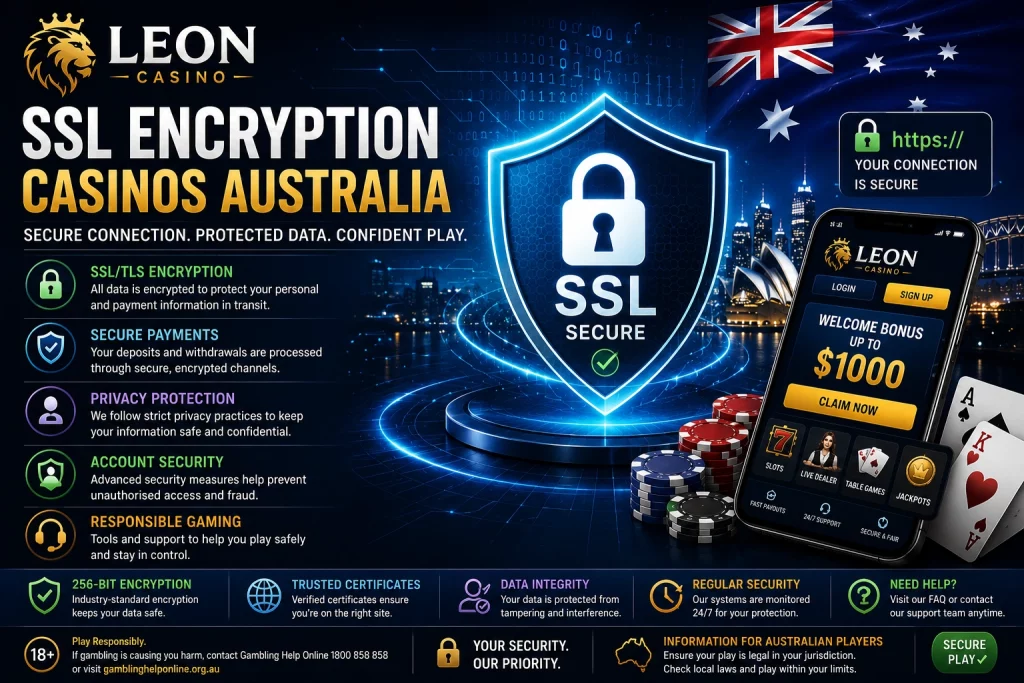
This makes encryption essential for any gambling-related website that handles account details, identity verification, payment information, support messages, and user settings. However, encryption is not the same as consumer protection. A site can use HTTPS and still have unclear ownership, weak privacy practices, poor withdrawal rules, or unsafe promotional behaviour. For Australian readers, encryption should be the starting point, not the final verdict.
SSL vs TLS: What the Term Really Means
Many people still say “SSL encryption”, but most modern secure websites use TLS, which replaced older SSL protocols. The term SSL remains common in SEO and website copy because users recognise it, but the technical standard is usually TLS. For a reader, the practical sign is HTTPS in the browser address bar and a valid security certificate.
When a user visits a website over HTTPS, the browser and server establish an encrypted connection. This makes it much harder for outsiders to read information moving between the user and the website. For casino-related pages, this may include login credentials, account forms, payment requests, identity-document uploads, and support messages. Without HTTPS, sensitive information can be exposed more easily during transmission.
A valid certificate also helps confirm that the browser is connecting to the intended domain. This reduces the risk of some impersonation and interception attacks, although it does not remove all phishing risk. Users can still be tricked by fake websites with similar names, misleading ads, or copied designs. Encryption protects a connection; it does not guarantee that the website itself is trustworthy.
This is why a serious safety page should avoid exaggerated claims. SSL or TLS encryption is necessary, but not sufficient. It must sit alongside secure account access, privacy governance, payment controls, breach response, and responsible gambling safeguards.
SSL Encryption Safety Checklist for Australian Casino-Related Websites
| Security Area | What It Means | Why It Matters for Users | Official Resource |
|---|---|---|---|
| HTTPS connection | The website uses an encrypted HTTPS connection instead of plain HTTP. | Helps protect sensitive information such as passwords and payment details while data travels between browser and server. | Australian Cyber Security Centre HTTPS Guide |
| TLS certificate | The site uses a valid certificate to support encrypted communication and domain authentication. | Helps users confirm they are connecting securely to the intended website. | ACSC TLS and Certificates Guidance |
| Privacy obligations | The platform explains how personal information is collected, used, stored, shared, and protected. | Encryption protects transfer, but privacy policy explains broader data handling. | OAIC Australian Privacy Principles |
| Personal data security | The platform takes reasonable steps to protect personal information from misuse, loss, unauthorised access, modification, or disclosure. | Casino-related accounts may contain identity documents, payment records, and behavioural data. | OAIC Guide to Securing Personal Information |
| Legal gambling context | The site is clear about whether its services are lawful for Australian users. | Encryption does not fix legal uncertainty or lack of local consumer protection. | ACMA Online Gambling Services |
Where SSL Encryption Protects User Activity
SSL or TLS encryption is most important when a user sends sensitive information through a website. The Login area is one of the clearest examples because passwords and account identifiers should never move over an unsecured connection. A Bonus page may also connect to account eligibility, transaction history, and promotional settings, so related account data should be protected. A Sign up form can include name, email, phone number, date of birth, address, and identity-check information. An App should protect mobile sessions, API communication, and device-linked account activity. Slots and other rapid-play sections can create behavioural records that should be handled securely. Games activity may reveal spending patterns, preferences, and session timing. The FAQ should explain security, privacy, verification, and account protection in plain language. Responsible Links should direct users to official cyber safety, privacy, and gambling support resources.
This structure is important because encryption is not limited to the payment screen. Any area that processes account identity, settings, behaviour, communication, or financial activity should be protected. A platform that encrypts only payment forms but leaves other account areas weak is not applying security consistently.
Readers should also understand that encryption does not protect against every risk. It does not stop someone from using a weak password. It does not prevent phishing if a user enters information on a fake site. It does not guarantee fair terms. It does not ensure that an operator handles identity documents properly after upload. It does not prove that a service is legal in Australia.
A stronger security explanation therefore treats SSL encryption as one layer in a broader safety model. The more sensitive the data, the more layers are needed.
What SSL/TLS Protects
Why HTTPS Alone Is Not Enough
HTTPS is essential, but users should not assume that every HTTPS website is safe. A fraudulent website can also use HTTPS. A poorly regulated platform can still use a valid certificate. A site with unclear ownership can still show a lock icon. This is why technical encryption must be checked together with legal status, privacy policy quality, responsible gambling tools, and account security.
The OAIC explains that the Privacy Act includes 13 Australian Privacy Principles applying to covered organisations and agencies. These principles create a wider privacy framework than encryption alone. They relate to how personal information is collected, used, disclosed, accessed, corrected, and secured.
For a casino-related website, this means users should look beyond the browser lock. They should ask whether the platform explains what data is collected, how long it is kept, who can access it, whether third-party processors are involved, and what happens after account closure. If these answers are unclear, SSL encryption does not solve the privacy problem.
Australian users should also consider the gambling-law context. ACMA can investigate and take action where operators provide or advertise prohibited online gambling services. This matters because a website can be technically encrypted while still creating legal or consumer-protection risks for Australian users.
Practical Safety Standard for SSL Casino Pages
A reliable SSL casino safety page should avoid exaggerated technical language. Instead of saying “military-grade security” without explanation, it should describe the specific protections users can understand. These include HTTPS, valid certificates, strong authentication, secure document upload, encrypted payment flows, staff access controls, privacy policies, breach response, and user rights.
For Leon Casino, the responsible message should be direct: encryption protects data in transit, but users still need to check the full safety environment. A secure connection is necessary before sharing any personal or payment information, but it is only one requirement. Legal clarity, privacy transparency, responsible gambling controls, and user account protection must also be present.
A cautious reader should never share sensitive information on a page that does not use HTTPS. They should also avoid any site that has certificate warnings, broken security indicators, suspicious redirects, unclear domain names, or pressure-based prompts. If the browser warns that a connection is not private, the safest action is to stop immediately and not enter data.
SSL encryption is therefore best understood as a gatekeeping requirement. Without it, a platform fails a basic technical safety check. With it, the platform passes only the first check. The rest of the safety assessment still matters.
Certificate Validation and Browser Trust Signals
SSL encryption in casino-related websites depends on certificate validation. A browser does not simply accept any encrypted connection. It checks whether the website certificate is valid, whether the domain matches the certificate, whether the certificate chain leads back to a trusted certificate authority, and whether the certificate has expired or been revoked. These checks help protect users from some forms of impersonation and interception.
For Australian readers, this matters because gambling-related websites may ask for sensitive details at several points. A Login screen can expose account credentials if the connection is weak. A Sign up form can involve personal identity details. A Bonus area may connect to account status, promotional eligibility, transaction history, and user preferences. A mobile App may send data through APIs that should also be protected with TLS, not only through the visible website.
The Australian Cyber Security Centre explains that TLS uses certificates and Public Key Infrastructure to help parties identify each other through a trusted intermediary and create encrypted tunnels for secure information transfer. This is why certificate management is not only a technical back-end task. It directly affects whether users can trust that they are communicating with the correct website rather than an imitation or misconfigured domain.
A strong certificate setup should avoid outdated protocols, weak cipher suites, mixed content, expired certificates, and insecure redirects. If a website shows a browser warning such as “connection not private” or “certificate not valid”, the safest action is to stop immediately and not enter any personal, account, or payment information.
SSL Encryption and Account Security
SSL or TLS encryption protects data in transit, but account security requires additional controls. Encryption can help protect a password while it moves between browser and server, but it does not stop password reuse, phishing, weak account recovery, or unauthorised access after login. For casino-related platforms, this distinction is important because an account can contain identity data, payment records, session history, support messages, and responsible gambling settings.
A safer platform should combine TLS with strong password rules, session expiry, suspicious-login monitoring, secure password reset, and multi-factor authentication where possible. Multi-factor authentication adds a second proof of identity, making account compromise harder if a password is stolen or reused elsewhere. This is especially relevant for accounts that may store transaction history, payment settings, and verification details.
The Slots section of a gambling-related site can generate behavioural records, while Games activity can show session timing, product preferences, and spending patterns. These records are sensitive because they can reveal more than entertainment activity. They may show financial behaviour, frequency, risk patterns, or periods of intense use. Encryption helps protect transfer, but internal access controls and privacy governance are needed after the data reaches the platform.
A security-focused FAQ should therefore explain not only HTTPS but also passwords, account recovery, device sessions, document uploads, payment security, privacy rights, and support. Safe Links should guide readers to official cyber-safety and privacy resources rather than only commercial pages.
| Security Layer | What SSL/TLS Helps With | What It Does Not Solve Alone | Better Safety Standard |
|---|---|---|---|
| Browser connection | Encrypts data moving between the user’s browser and the website. | Does not prove that the operator is legal, fair, or privacy-compliant. | Check HTTPS, certificate validity, legal status, and privacy policy together. |
| Account access | Protects login details while they are transmitted. | Does not prevent weak passwords, reused passwords, phishing, or unsafe recovery processes. | Use unique passwords, secure recovery, session controls, and multi-factor authentication where available. |
| Payment forms | Helps protect payment data during submission. | Does not guarantee fair withdrawals, clear payment rules, or safe internal storage. | Review payment terms, withdrawal rules, processor details, and account-name checks. |
| Identity uploads | Helps protect documents while they are uploaded through a secure form. | Does not explain who can access documents or how long they are retained. | Look for secure upload portals, access limits, audit logs, and retention rules. |
| Behavioural data | Helps protect session activity while it moves through secure systems. | Does not prevent misuse of activity data for risky marketing or profiling. | Behavioural data should support safety, fraud prevention, and responsible gambling controls. |
Mixed Content and Unsafe Redirects
One common weakness in poorly managed websites is mixed content. This happens when the main page loads over HTTPS, but some images, scripts, forms, frames, or resources load over unsecured HTTP. Mixed content can weaken the page because sensitive elements may not receive the same protection as the main connection. It can also create browser warnings or block parts of the page from loading correctly.
For a casino-related website, mixed content is not acceptable on any page that handles account activity, payment data, identity verification, responsible gambling settings, or support messages. The entire user journey should remain secure. A platform should not protect only the homepage while leaving secondary account areas, forms, or embedded tools weaker.
Unsafe redirects are another issue. A secure page should not move users through unclear domains, suspicious shortened links, or HTTP redirects before reaching a final page. Redirects can be legitimate, especially for payment processors or identity verification providers, but they should be transparent and controlled. If a user is moved between several unfamiliar domains without explanation, that is a warning sign.
Security is strongest when the platform applies HTTPS consistently across all pages, subdomains, APIs, forms, and mobile endpoints. Inconsistent encryption suggests weak technical governance.
Strong vs Weak SSL Implementation
SSL Encryption and Personal Information Security
Australian privacy guidance makes it clear that personal information security is broader than encryption. The OAIC’s Guide to securing personal information explains that entities covered by the Privacy Act must take reasonable steps to protect personal information from misuse, interference, loss, unauthorised access, modification, and disclosure. This means encryption is part of a wider privacy and security program, not a standalone solution.
For casino-related websites, this wider program should include secure collection, controlled access, staff training, supplier management, data retention limits, breach response, and secure destruction or de-identification when information is no longer needed. A site may use HTTPS correctly but still mishandle data internally if too many staff can access documents, if retention periods are unclear, or if third-party processors are not governed properly.
Personal information in this context can include account details, identity documents, payment references, contact information, device data, login records, and support messages. Some of this data may also be linked to gambling behaviour, which makes it more sensitive from a privacy and wellbeing perspective. A platform should not use technical security language to avoid explaining how this data is actually managed.
A safer privacy approach is transparent. Users should know what is collected, why it is needed, how long it is stored, who can access it, whether it is shared, and how to ask questions or request corrections.
SSL Encryption and Responsible Gambling Data
Responsible gambling data can be especially sensitive. A user may set deposit limits, activate time-outs, request self-exclusion, contact support about gambling harm, or change account controls during a period of stress. These records should be handled carefully because they can reveal private information about financial behaviour, emotional wellbeing, and risk.
SSL/TLS helps protect responsible gambling requests while they are submitted, but the platform must also protect the records after submission. Access should be limited. Marketing teams should not use self-exclusion or harm-related indicators for promotional targeting. Support teams should respond carefully, and account systems should enforce limits reliably.
The Australian Privacy Principles include security obligations for personal information, including reasonable steps to protect information from misuse, interference, loss, unauthorised access, modification, or disclosure. This supports the broader point: technical encryption is necessary, but privacy governance determines whether sensitive account records remain protected after transmission.
For Leon Casino, the editorial message should be cautious and user-centred. SSL encryption should be described as a baseline requirement for all account and data flows. It should never be used to imply that gambling is risk-free or that a website is automatically safe. Strong security protects data; responsible gambling controls protect people. Both are needed.
Secure Payment Pages and Encrypted Transactions
SSL encryption becomes especially important when a casino-related website handles payment information. Deposit forms, withdrawal requests, payment-method changes, balance checks, refund requests, and verification screens can all involve sensitive financial data. Even when a platform uses a third-party payment processor, the user journey should remain secure from the first click to the final confirmation page.
A safer platform should not redirect users through unclear domains or unsecured payment screens. If a payment page suddenly changes to an unfamiliar address, loses HTTPS protection, or displays a browser warning, the safest action is to stop immediately. Payment security depends on a continuous secure flow, not only on the first page of the website.
It is also important to understand that encryption protects transmission, not business fairness. A payment form may be encrypted, but that does not prove that withdrawal terms are fair, verification is clear, or refunds are easy to resolve. Users should always separate technical security from operational trust. Both matter, but they are not the same thing.
For Leon Casino, the payment security explanation should be direct: encrypted payment pages are necessary, but users should also check transaction history, withdrawal terms, identity requirements, support routes, and responsible gambling limits. A secure connection helps protect information during transfer. Transparent rules help protect the user after the transaction.
| Payment Security Point | Safer Standard | Risky Signal | User-Safe Response |
|---|---|---|---|
| Payment page encryption | The full payment journey remains on HTTPS pages with no browser warnings. | The page redirects to unsecured HTTP, unknown domains, or pages with certificate errors. | Do not enter payment details if the browser shows any security warning. |
| Payment processor clarity | The platform explains whether payments are handled directly or through a third-party provider. | The user is moved between payment screens without explanation or recognisable processing details. | Pause and verify the processor before sharing financial data. |
| Withdrawal transparency | Withdrawal rules, processing times, fees, identity checks, and limits are explained before payment activity. | Withdrawal conditions appear only after deposits or after a user requests a payout. | Do not rely on encrypted deposits alone; review withdrawal rules first. |
| Transaction history | Users can clearly review deposits, withdrawals, pending requests, reversals, and account adjustments. | Transaction records are incomplete, unclear, delayed, or difficult to access. | Keep independent records and avoid platforms with poor financial visibility. |
| Responsible gambling limits | Deposit limits, time-outs, and account controls are visible before and during payment activity. | The platform makes deposits easy but makes limits or account pauses hard to find. | Use limits early and stop if payment activity creates stress or secrecy. |
SSL Encryption and Identity Document Uploads
Identity document uploads require a higher level of caution than ordinary account forms. A user may be asked to upload a passport, driving licence, proof of address, payment confirmation, or bank-related document. These files are highly sensitive because they can be misused if exposed, copied, stored poorly, or shared without proper safeguards.
SSL/TLS helps protect documents while they are being uploaded, but it does not answer every privacy question. Users should still know why the document is required, whether the upload portal is secure, who can access the file, how long it is retained, whether it is shared with verification providers, and how it is deleted or archived after the check is complete.
A safer platform should provide a dedicated secure upload area rather than asking users to send identity documents through ordinary email, social media, or live chat attachments. Email can be convenient, but it is not always the safest way to handle identity files. Secure portals give the platform more control over access, logging, storage, and deletion.
For casino-related websites, verification should also be predictable. A platform should not surprise users with unclear document demands only after a withdrawal request. Verification may be necessary, but the rules should be explained during Sign up, in the account area, and in the FAQ. If a platform repeatedly asks for new documents without clear reason, that is not a strong privacy signal.
Server-Side Protection After Data Is Received
The most common misunderstanding about SSL encryption is assuming that data is safe forever once it travels over HTTPS. Encryption in transit is only one phase. After information reaches the platform, server-side protection becomes the next major requirement. This includes secure databases, access control, encryption at rest, audit logs, monitoring, backups, patch management, and staff permissions.
For example, a Login password may be protected while submitted, but it must also be stored correctly. A password should never be stored in plain text. Payment records should not be visible to unnecessary staff. Identity documents should not sit in open folders. Support messages should not be downloadable by employees who do not need them. Technical protection must continue after the user clicks submit.
Server-side security also affects App users. A mobile app may look separate from the website, but it usually communicates with back-end systems through APIs. Those API calls should be secured, authenticated, monitored, and protected against abuse. If an app stores tokens poorly, allows insecure sessions, or sends data through weak endpoints, the visual presence of HTTPS on the website does not solve the app risk.
For Leon Casino, this section should explain that SSL is the visible layer, while server-side protection is the operational layer. Users can see the browser lock, but they cannot directly see database configuration, staff access rules, or internal monitoring. That is why privacy policy quality, security explanations, audit culture, and support transparency are important trust signals.
Why Strong Password Policies Still Matter
SSL encryption does not protect users from weak passwords. If a user chooses a simple password, reuses the same password across multiple services, or enters login details into a fake website, encryption cannot fully prevent account compromise. A secure connection protects the path, but the account itself still needs strong access controls.
A safer gambling-related platform should encourage strong passwords and support additional protections for sensitive actions. This includes password changes, account recovery, withdrawal requests, payment-method updates, email changes, and document uploads. These actions should not be treated as ordinary clicks. They involve personal and financial data.
Password reset flows are especially important. A weak reset process can become a back door into the account. If an attacker can reset access through easily guessed information or poorly verified support messages, the account is vulnerable even when the website uses TLS. A safer platform uses secure reset links, time limits, confirmation messages, and extra checks for high-risk changes.
Users should also avoid saving gambling-related passwords on shared devices. A shared browser, school or workplace device, family tablet, or borrowed phone can expose account sessions. If a user must access an account, they should log out fully and avoid saving credentials. This is basic account hygiene, but it matters when accounts contain payment and identity data.
Encryption and Game Activity Records
Game activity records may not seem as sensitive as identity documents, but they can still reveal private patterns. Slots sessions, Games history, deposit timing, session duration, product preferences, and promotional interactions can show when and how a person gambles. This information can become sensitive when linked with financial behaviour or responsible gambling indicators.
SSL/TLS helps protect these records while they move between the user device and the platform. However, the platform must also control how these records are stored and used. Behavioural data should not be treated as ordinary marketing material. It can reveal signs of risk, such as repeated deposits, late-night sessions, chasing losses, or increasing session length.
A safer platform uses behavioural data for security, fraud detection, responsible gambling tools, and account safety. A weaker platform may use the same data mainly to push more promotional messages. That is a major difference. Data protection is not only about stopping external attackers. It is also about ethical internal use.
For an Australian-facing safety page, the right message is clear: behavioural data should be protected because it can reveal personal habits, financial pressure, and gambling risk. Encryption helps move that data safely, but governance decides whether the data is used responsibly.
SSL Encryption and Promotional Data
Promotional systems can involve more data than users expect. A Bonus page may process eligibility, account age, deposit history, previous claims, product preferences, location-related restrictions, and marketing consent. These data points should be protected and explained. A user should know whether promotional eligibility is based on account activity and whether marketing preferences can be changed.
A safer platform separates account security messages from marketing messages. Security alerts, password reset emails, payment confirmations, and responsible gambling notices should not be mixed with promotional pressure. Users should be able to unsubscribe from marketing without losing important account security communications.
Promotional data also needs careful handling after time-outs or self-exclusion. If a user has chosen to pause or stop gambling, the platform should not continue sending messages designed to bring them back. Encryption can protect the delivery of messages, but privacy and responsible gambling policies determine whether those messages should be sent at all.
For Leon Casino, promotional data should be discussed cautiously. The page should explain how account and marketing data should be secured, but it should not frame promotions as risk-free. Data protection and responsible gambling must work together.
User-Side Checks Before Trusting SSL Claims
Users can perform several simple checks before trusting a website’s SSL claim. First, they should confirm that the address starts with HTTPS and that the browser does not show a warning. Second, they should check that the domain name is spelled correctly and does not contain unusual characters, extra words, or suspicious substitutions. Third, they should avoid links from unsolicited emails, messages, or ads that create urgency.
Users should also be cautious with pop-ups that ask for login details, payment information, or identity documents. A secure website should keep sensitive processes inside clear account areas, not through random windows or third-party-looking prompts. If something feels rushed or inconsistent, the safest action is to stop.
A security-focused FAQ should explain these user checks in plain language. It should not assume that every reader understands certificate warnings, phishing, or mixed content. Good safety content teaches users what to look for and what to avoid.
Safe Links should also point readers toward official cyber and privacy resources. Commercial pages may explain platform features, but official resources help users understand broader risks. For Australian readers, that distinction matters because online gambling, privacy, and cyber safety overlap.
Practical Standard for Leon Casino SSL Content
For Leon Casino, the SSL Encryption Casinos Australia page should define SSL/TLS as a baseline technical requirement. It should explain that secure transmission is necessary before any user shares account, payment, identity, or support information. At the same time, it should state clearly that SSL does not guarantee legal safety, withdrawal fairness, privacy compliance, or responsible gambling quality.
A strong page should use specific language. Instead of saying only “protected by SSL”, it should explain encrypted connection, valid certificate, secure forms, account authentication, safe document uploads, protected payment flows, server-side access controls, and user-side checks. This makes the page more useful and more trustworthy.
It should also avoid overpromising. Phrases such as “100% safe” or “fully risk-free” are not appropriate for gambling-related content. No encryption system removes financial risk from gambling. No lock icon proves that a user should deposit money. No certificate can replace careful reading of terms, privacy policies, and responsible gambling controls.
The safest conclusion for this section is simple: SSL encryption protects data in transit, but complete safety requires many more layers. Users should verify the connection, protect their account, read the privacy policy, avoid suspicious links, review payment rules, and stop if gambling creates financial or emotional pressure.
Common SSL Misconceptions in Online Casino Safety
SSL encryption is important, but it is often misunderstood. Some users see a padlock icon and assume the entire platform is safe. That is not correct. SSL or TLS encryption protects the connection between the user and the website, but it does not prove that the operator is legally compliant, financially fair, privacy-conscious, or responsible with gambling-harm controls.
One common misconception is that HTTPS means a website is trustworthy. HTTPS means the connection is encrypted and the certificate is valid for the domain. A fraudulent website can still use HTTPS. A fake page can still show a padlock. A copied gambling-related site can still use a valid certificate if the attacker controls the domain. This is why users must check the exact website address, privacy policy, operator details, and legal status, not only the browser icon.
Another misconception is that SSL protects stored data forever. It does not. SSL protects data during transfer. Once data reaches the server, protection depends on internal systems: encrypted storage, restricted staff access, audit logs, secure backups, patching, breach response, and third-party controls. A platform can transmit information securely but still store it poorly.
A third misconception is that SSL removes gambling risk. It does not. Encryption protects data, not decision-making. It does not prevent chasing losses, overspending, emotional gambling, unclear terms, or unsafe promotional pressure. A responsible page about SSL Encryption Casinos Australia should therefore connect technical safety with privacy, account protection, and responsible gambling awareness.
Final SSL Safety Checklist for Australian Readers
| Final Check | What to Look For | Why It Matters | Safe Action |
|---|---|---|---|
| HTTPS on every page | The whole site, including account pages, forms, payment screens, support areas, and document upload pages, uses HTTPS. | Partial encryption can leave sensitive account or payment activity exposed. | Do not enter information on any page that is not protected by HTTPS. |
| Valid certificate | The browser shows no certificate warning, domain mismatch, expiry problem, or “connection not private” alert. | Certificate problems may indicate misconfiguration, impersonation, or unsafe routing. | Stop immediately if the browser displays a security warning. |
| Correct domain | The website address is spelled correctly and does not contain strange characters, added words, or suspicious redirects. | Phishing pages can imitate casino-related brands while using similar-looking domain names. | Type the address manually or use trusted bookmarks rather than urgent message links. |
| Secure account access | The platform supports strong passwords, session expiry, secure recovery, suspicious-login alerts, and multi-factor authentication where possible. | SSL protects transmission, but weak account controls can still expose user data. | Use a unique password and enable additional security controls where available. |
| Safe document upload | Identity documents are uploaded through a secure portal with clear privacy and retention information. | ID files can create serious fraud and privacy risk if mishandled. | Avoid sending sensitive documents through ordinary email, chat, or suspicious forms. |
| Transparent payment flow | Payment pages remain encrypted and withdrawal rules are explained before any money is involved. | Encrypted deposits do not prove fair withdrawals or clear financial rules. | Review payment terms before sharing financial details. |
| Responsible gambling controls | Limits, time-outs, self-exclusion, account closure, and support resources are visible and easy to use. | Technical security does not replace harm-prevention tools. | Use protective tools early if gambling creates stress, secrecy, or financial pressure. |
How Leon Casino Should Present SSL Information
Leon Casino should present SSL encryption as a technical requirement, not as a complete safety promise. The page should explain that secure transmission is necessary for any page that handles account details, verification forms, payment activity, support messages, or responsible gambling settings. It should also explain that SSL is only one part of a wider safety framework.
The Login section should focus on secure access, password protection, session expiry, and suspicious activity alerts. The Sign up section should explain why personal details are collected and how forms should be encrypted. The Bonus section should clarify that promotional eligibility data may be processed securely, but users should still read terms carefully. The App section should cover encrypted mobile communication, secure sessions, push notification controls, and device safety.
The Slots and Games sections should explain that activity records can be sensitive because they may show session frequency, spending patterns, and product preferences. The FAQ should answer plain-language security questions about HTTPS, certificates, payment pages, document uploads, password resets, and privacy rights. Responsible Links should point users toward official cyber safety, privacy, and gambling-support information.
This approach keeps the page useful and responsible. It avoids making SSL sound like a guarantee of gambling safety. It also helps users understand the difference between technical protection and broader consumer protection.
SSL Encryption and Mobile Casino Access
Mobile access creates additional SSL and TLS considerations. A website may show HTTPS in a browser, but a mobile app also communicates with servers through background connections and APIs. These connections should be encrypted, authenticated, and protected against interception. Users cannot always see these app-level connections, which means trust depends on the platform’s technical governance and privacy transparency.
A safer mobile platform should protect login sessions, account tokens, payment requests, notification settings, document uploads, and support messages. It should also avoid storing sensitive information insecurely on the device. If a phone is lost, shared, or compromised, the app should not expose account details without additional authentication.
Push notifications are another mobile risk area. Security alerts and payment confirmations can be useful, but promotional notifications can create pressure. A responsible platform should allow users to manage notification categories clearly. Account security messages should be separate from marketing messages.
Users should also apply basic mobile safety. They should keep the operating system updated, avoid jailbroken or rooted devices, use screen locks, avoid public Wi-Fi for sensitive account activity, and log out from shared devices. SSL protects the connection, but device security still matters.
What SSL Cannot Protect Against
SSL encryption cannot protect users from every casino-related risk. It cannot make an illegal or unclear operator safe. It cannot make unfair terms fair. It cannot guarantee withdrawals. It cannot prevent a user from entering information into a fake website. It cannot stop a platform from storing data longer than necessary. It cannot prevent gambling harm.
This limitation matters because many gambling-related sites use security language to create trust. Phrases like “encrypted”, “secure”, and “protected” may be technically true but still incomplete. A user should ask what is protected, when it is protected, and what happens after data reaches the platform.
SSL also cannot protect against social engineering. A user may receive a fake email, copied support message, misleading ad, or urgent text asking them to click a link. If they enter credentials on a fake page, the attacker may receive the information even if the fake page uses HTTPS. That is why domain checks and phishing awareness are essential.
SSL does not protect against unsafe gambling behaviour either. If a person gambles with essential money, chases losses, hides activity, or feels unable to stop, the issue is not encryption. The issue is harm risk. A responsible SSL page should state this clearly.
Final Conclusion: SSL Encryption Casinos Australia
SSL encryption is a baseline requirement for any casino-related website in Australia. Without HTTPS, valid certificates, secure forms, and protected payment or document upload flows, a platform fails a basic technical safety check. Users should never enter passwords, personal details, payment information, or identity documents on an unsecured page.
However, SSL encryption is only the first layer. A secure connection does not prove legal safety, privacy compliance, fair withdrawals, ethical data use, or responsible gambling quality. Complete safety assessment requires a wider review: legal status, operator transparency, privacy policy, data retention, account security, payment rules, breach response, support quality, and harm-prevention tools.
For Leon Casino, the correct editorial position is cautious and transparent. SSL/TLS should be described as necessary protection for data in transit, but not as a guarantee that gambling is risk-free. The page should help readers understand both what encryption does and what it cannot do.
The safest user rule is simple: check HTTPS, verify the domain, avoid browser warnings, use strong account protection, read privacy and payment terms, avoid suspicious links, and never treat encryption as a reason to ignore gambling risk. A lock icon protects the connection. It does not replace judgement, legal awareness, privacy review, or responsible gambling boundaries.






Comments