

Structure, wheel formats, bet types and RTP fundamentals
Roulette remains one of the most structurally transparent casino Games ever created. Its appeal lies in simplicity: a spinning wheel, a numbered pocket layout, and clearly defined probability.
Unlike feature-driven Slots, roulette does not rely on bonus mechanics, scatter symbols or volatility clustering. Every spin is independent. Every result is determined by physical or digital randomisation.
Players typically access roulette after secure authentication through the Login page, where balance integrity and limits are confirmed before play begins.
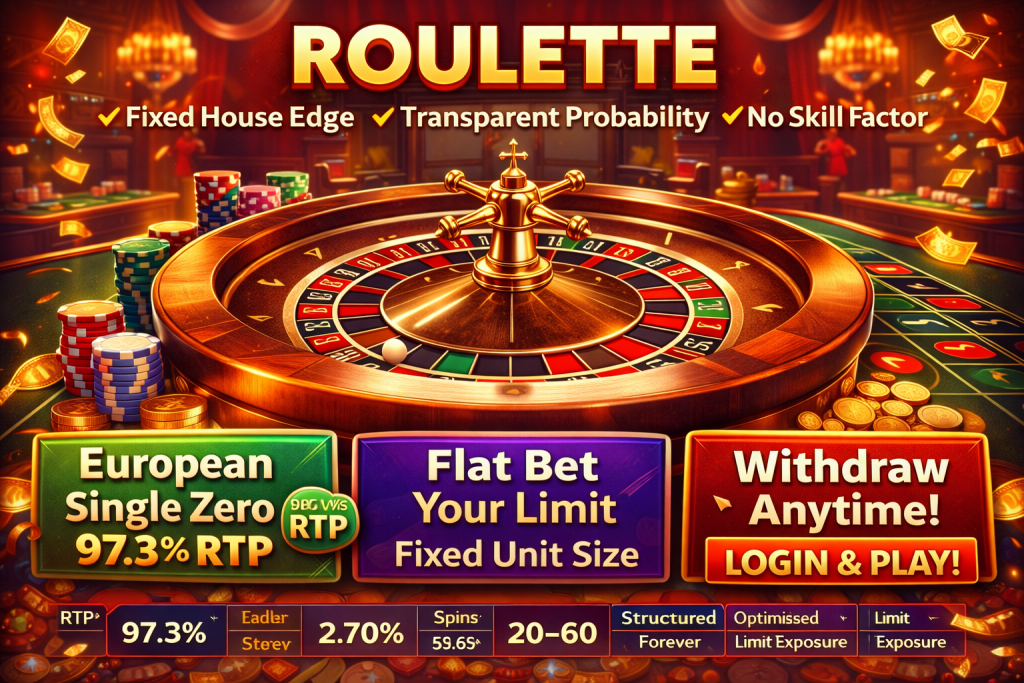
Core Roulette Variants
Roulette exists in three primary formats:
| Variant | Wheel Numbers | House Edge | Zero Configuration |
|---|---|---|---|
| European Roulette | 37 | 2.70% | Single 0 |
| French Roulette | 37 | 2.70% (lower with La Partage) | Single 0 |
| American Roulette | 38 | 5.26% | 0 and 00 |
European and French versions provide lower house edge due to single zero.
American roulette introduces double zero, increasing operator margin.
For long-term sustainability, single-zero formats are statistically superior.
Basic Bet Categories
Roulette bets are divided into:
Inside Bets
- Straight Up (single number)
- Split (two numbers)
- Street (three numbers)
- Corner (four numbers)
- Six Line (six numbers)
Outside Bets
- Red / Black
- Odd / Even
- High / Low
- Dozens
- Columns
Inside bets offer higher payout but lower probability.
Outside bets offer lower payout but higher hit frequency.
Probability Structure Overview
European Roulette probability distribution:
| Bet Type | Win Probability | Payout |
|---|---|---|
| Straight Up | 2.70% | 35:1 |
| Split | 5.40% | 17:1 |
| Red/Black | 48.65% | 1:1 |
| Dozen | 32.43% | 2:1 |
| Column | 32.43% | 2:1 |
The 2.70% house edge derives entirely from the zero pocket.
Without zero, outside bets would return 50%.
European Roulette Probability Breakdown
RTP Fundamentals
European Roulette RTP = 97.30%
American Roulette RTP = 94.74%
The difference arises solely from wheel structure.
French Roulette with La Partage reduces effective house edge on even-money bets to 1.35%.
This makes French roulette statistically optimal for conservative players.
Independence Principle
Every spin:
- Is independent
- Has identical probability
- Is unaffected by prior results
The belief that a color is “due” after repeated opposite outcomes is incorrect.
Roulette follows fixed mathematical expectation.
At this point, it becomes necessary to address how players interpret randomness in real time. Even when the independence principle is clearly understood on a theoretical level, actual gameplay often introduces pattern-seeking behavior. Sequences such as repeated colors or clustered numbers create an illusion of structure, leading players to adjust bets based on perceived trends. In reality, these adjustments do not improve probability outcomes — they simply redistribute exposure across different bet types without affecting the fixed house edge.
Another important layer is session-based perception drift. Over shorter sessions, variance can create the impression that certain strategies “work,” especially when outcomes temporarily align with expectations. However, as the number of spins increases, results begin to converge toward the theoretical distribution defined by the wheel structure. This is why roulette often feels predictable in the short term but becomes mathematically consistent over extended play. Recognizing this shift helps prevent overconfidence and reinforces the importance of fixed staking and predefined session limits.
Strategic Structures
Common roulette approaches include:
- Flat betting
- Martingale progression
- Fibonacci system
- D’Alembert method
- Paroli positive progression
All systems redistribute variance.
None change house edge.
House edge remains fixed per spin.
Ecosystem Placement
Roulette often sits alongside other table classics such as:
- Roulette
- Blackjack
- Poker
- Bingo
- Live casino
These titles appeal to players seeking probability transparency rather than feature-based volatility.
Platform Access and Mobile Integration
Players may access roulette via browser or dedicated App interfaces.
Mobile optimisation ensures:
- Smooth wheel animation
- Instant bet placement
- Clear chip stacking
- Accurate payout confirmation
Probability remains server-determined or RNG-based.
Onboarding Flow
New players frequently explore roulette shortly after Sign up, particularly when seeking lower volatility alternatives to high-variance slot environments.
Roulette rarely integrates directly with standard slot-style Bonus wagering at full contribution; terms must be reviewed carefully.
Advanced Betting Systems Overview
Roulette has inspired countless betting systems. While none can eliminate the house edge, they alter variance distribution and bankroll exposure.
Below is a structured comparison of commonly used systems:
| System | Structure | Risk Level | Bankroll Requirement | Sustainability |
|---|---|---|---|---|
| Flat Betting | Same stake each spin | Low | Low | High |
| Martingale | Double after loss | Very High | Large | Low |
| Fibonacci | Progressive sequence | High | Medium | Moderate |
| D’Alembert | Increase by 1 after loss | Moderate | Medium | Moderate |
| Paroli | Double after win | Moderate | Medium | Balanced |
All systems face the same fixed house edge of 2.70% (European wheel).
Variance differs. Expectation does not.
Martingale Risk Compression
Martingale structure:
- Bet on even-money outcome (e.g., red).
- Double stake after each loss.
- Recover all previous losses plus one unit profit on first win.
Example escalation sequence:
| Spin | Stake | Outcome | Net Result |
|---|---|---|---|
| 1 | $10 | Loss | -10 |
| 2 | $20 | Loss | -30 |
| 3 | $40 | Loss | -70 |
| 4 | $80 | Win | +10 |
While recovery appears certain, long losing streaks produce exponential exposure.
Table limits cap progression.
Bankroll exhaustion remains the primary failure risk.
Variance vs Expectation
Roulette expectation remains constant regardless of strategy.
However, variance distribution changes:
- Flat betting → gradual fluctuation
- Martingale → infrequent large exposure
- Paroli → capitalises on streaks
Risk tolerance defines system suitability.
European vs American Structural Risk
| Feature | European | American |
|---|---|---|
| Zero Pockets | 1 | 2 |
| House Edge | 2.70% | 5.26% |
| RTP | 97.30% | 94.74% |
| Long-Term Stability | Higher | Lower |
The additional 00 pocket significantly increases volatility against player expectation.
Single-zero wheels provide better mathematical efficiency.
Bankroll Allocation Framework
Structured bankroll management improves long-term sustainability.
Below is a simplified model:
| Bankroll | Recommended Unit | Max Bet | Spin Limit | Risk Profile |
|---|---|---|---|---|
| $200 | $5 | $20 | 40–60 spins | Controlled |
| $500 | $10 | $40 | 50–80 spins | Balanced |
| $1000 | $20 | $80 | 60–100 spins | Moderate |
| $2000+ | Variable | Structured cap | Controlled | Conservative |
Higher unit sizes reduce session runway.
Even low house edge accumulates over time.
Streak Perception Bias
Roulette streaks often mislead players.
Example: 8 consecutive reds.
Probability next spin red remains 48.65% (European).
Independence principle remains absolute.
Historical outcomes do not affect future probability.
Volatility Comparison to Slots
| Attribute | Roulette | High Volatility Slots |
|---|---|---|
| RTP Stability | Consistent | Feature-weighted |
| Volatility | Moderate | High |
| Player Control | Bet placement | None |
| Emotional Rhythm | Measured | Intense |
| Exposure Speed | Controlled | Accelerated |
Roulette provides slower variance compression than many modern Slots.
It appeals to probability-driven players.
House Edge Comparison
Bonus Compatibility and Wagering
Roulette contribution toward wagering requirements often differs from slot-based Bonus structures.
Some platforms:
- Reduce contribution percentage
- Exclude even-money bets
- Impose maximum bet restrictions
Players must verify contribution rules before wagering.
Roulette’s low house edge does not always align with bonus optimisation.
Platform Access and Session Integrity
Players typically access roulette after secure Login, ensuring accurate balance reconciliation.
Mobile access via dedicated App environments maintains consistent RNG logic.
Wheel outcomes remain independent of device.
Behavioural Stability Zones
Roulette behaviour generally follows:
- Conservative entry (even-money bets)
- Progressive experimentation
- Risk escalation
- Stabilisation or exit
Structured exit rules reduce exposure drift.
Live Roulette vs RNG Roulette
Roulette exists in two primary operational formats:
- RNG (Random Number Generator) digital wheel
- Live dealer streamed wheel
Both follow identical probability structure when using the same wheel format (European or American). The difference lies in execution environment.
| Feature | RNG Roulette | Live Roulette |
|---|---|---|
| Wheel Type | Digital simulation | Physical wheel |
| Result Source | Certified RNG | Physical spin |
| Speed | Faster | Slower |
| Social Interaction | None | Present |
| House Edge | Same (variant dependent) | Same (variant dependent) |
Mathematically, expectation remains identical.
RNG Integrity and Certification
Digital roulette wheels rely on certified RNG systems.
Key integrity features:
- Independent spin outcomes
- Certified random distribution
- Regulatory compliance
- Periodic audit testing
Outcomes are determined before animation. Visual representation follows algorithmic result.
Device type does not alter probability.
Live Wheel Bias Myth
Some players believe physical wheels develop bias.
In regulated environments:
- Wheels are maintained regularly
- Dealer spin technique varies naturally
- Bias is statistically negligible
Modern live roulette platforms calibrate wheels to eliminate predictable deviation.
Probability remains stable.
Long-Term Sustainability Modelling
Over extended sessions, house edge accumulates.
Example simulation (European wheel, flat betting):
| Spins | Total Wagered | Expected Loss (2.70%) |
|---|---|---|
| 100 | $1000 | $27 |
| 500 | $5000 | $135 |
| 1000 | $10000 | $270 |
Variance may produce short-term deviation, but expectation converges over time.
Sustainability depends on limiting exposure.
Variance Compression Over Time
Short sessions may show:
- Positive deviation
- Neutral outcome
- Negative swing
Long sessions tend to approach theoretical expectation.
Roulette is lower variance compared to many high-volatility slot Games, but extended exposure increases total expected loss.
Betting Distribution and Risk Spectrum
| Bet Type | Risk Level | Win Frequency | Payout | Volatility |
|---|---|---|---|---|
| Even-Money | Low | High | 1:1 | Mild |
| Dozens | Moderate | Medium | 2:1 | Moderate |
| Straight-Up | High | Low | 35:1 | High |
| Combination Spread | Variable | Variable | Mixed | Flexible |
Risk profile is player-defined.
Wheel probability remains constant.
Psychological Stability in Roulette
Roulette produces slower emotional cycling than feature-heavy slots.
Phases typically include:
- Conservative entry
- Small win reinforcement
- Progressive adjustment
- Exposure drift
Progressive systems amplify volatility beyond wheel structure.
Structured exit prevents drift.
Comparison With Blackjack and Poker
Roulette differs from skill-based table formats:
| Attribute | Roulette | Blackjack | Poker |
|---|---|---|---|
| Skill Impact | None | Moderate | High |
| House Edge | Fixed | Variable | Variable |
| Player Decision Influence | Bet placement only | Card decisions | Strategic depth |
| Predictive Edge Possible | No | Limited | Yes (player vs player) |
Roulette is purely probabilistic.
Skill cannot reduce house edge.
Cross-Device Consistency
Players access roulette after secure Login, ensuring accurate session accounting.
Mobile optimisation via dedicated App maintains identical wheel logic.
Probability does not vary between desktop and mobile.
Bonus and Wagering Limitations
Roulette may contribute differently toward wagering compared to slot-based Bonus structures.
Common restrictions include:
- Lower contribution percentage
- Exclusion of even-money bets
- Maximum bet cap
Verification of terms remains essential before play.
Long-Term Exposure Model
Sustainable roulette engagement includes:
- Fixed betting unit
- Defined spin cap
- Stop-loss limit
- No exponential progression
Flat betting reduces volatility spike risk.
Behavioural Discipline Framework
To stabilise exposure:
- Avoid doubling systems
- Limit straight-up concentration
- Define exit threshold
- Avoid chasing streaks
House edge remains constant regardless of strategy.
Responsible Calibration Model
Roulette offers structural transparency, but sustainability depends entirely on behavioural discipline. Because the house edge is fixed, long-term exposure increases expected loss regardless of short-term variance.
Responsible calibration includes:
- Fixed betting unit
- Defined session duration
- Stop-loss threshold
- Stop-win threshold
- No escalation after losses
Without structure, even low house edge accumulates over time.
Stop-Loss and Stop-Win Framework
Structured exit rules reduce variance drift.
Below is a simplified calibration model:
| Scenario | Recommended Action | Exposure Control |
|---|---|---|
| 10 consecutive losses (even-money) | Pause session | Prevents escalation |
| 50% bankroll reduction | Stop play | Protects capital |
| 30%+ bankroll increase | Lock profit | Preserves gain |
| Emotional tilt detected | Exit immediately | Risk stabilisation |
Even-money bets create false perception of safety. Loss streaks remain statistically possible.
Withdrawal Validation and Balance Integrity
After a profitable session, platforms must ensure:
- Instant balance update
- Transparent transaction history
- Clear withdrawal eligibility
- Defined processing times
Trust in roulette does not depend solely on wheel fairness but also on financial reliability.
Players often test small withdrawals after profitable sessions to validate liquidity.
Infrastructure transparency reinforces confidence.
Comparative RTP Positioning
Roulette’s RTP depends on wheel structure:
| Game | RTP | House Edge |
|---|---|---|
| French Roulette (La Partage) | ~98.65% (even bets) | 1.35% |
| European Roulette | 97.30% | 2.70% |
| American Roulette | 94.74% | 5.26% |
| Average Slot | 94%–97% | Variable |
Single-zero roulette often provides better mathematical efficiency than many online Slots, particularly high-volatility titles.
However, extended exposure still compounds house edge.
Variance Compared to Other Casino Games
Roulette occupies a middle ground:
| Attribute | Roulette | High Volatility Slots | Crash Games |
|---|---|---|---|
| RTP Stability | High | Feature-weighted | Multiplier-weighted |
| Emotional Intensity | Moderate | High | Very High |
| Exposure Speed | Controlled | Moderate | Rapid |
| Skill Impact | None | None | Timing only |
Roulette offers steady volatility compared to aggressive variance formats.
Behavioural Risk Zones
Common roulette risk zones include:
- Streak chasing
- Progressive doubling
- Post-win overconfidence
- “Due number” bias
Mitigation strategies:
- Flat betting
- Defined exit thresholds
- No reactive stake increases
- Session cap
Expectation remains constant.
Long-Term Exposure Simulation
Over 1000 spins at $10 per spin (European wheel):
Total wagered = $10,000
Expected theoretical loss = $270
Variance may produce deviation, but convergence trends toward expectation.
Roulette rewards short controlled sessions more than long continuous exposure.
Platform Access and Session Continuity
Players typically enter roulette after secure Login, ensuring correct balance reconciliation.
New players may explore roulette shortly after Sign up, particularly when seeking lower volatility alternatives to feature-driven slot environments.
Mobile play through a dedicated App ensures identical probability logic and consistent wheel behaviour.
Probability is independent of device.
Bonus Contribution Considerations
When playing with a Bonus, players must confirm:
- Contribution percentage
- Maximum bet restrictions
- Eligible bet types
- Wagering multiplier
Roulette may contribute less toward wagering compared to other casino Games.
Reviewing terms prevents disqualification.
Concluding Perspective
Roulette remains one of the most mathematically transparent casino formats available.
There are no hidden mechanics.
There are no adaptive payouts.
There are no progressive volatility shifts.
Each spin is independent.
Each bet has defined probability.
House edge remains constant.
Short-term results vary.
Long-term expectation converges.
Roulette does not reward prediction.
It rewards control.
Recent technological advancements have improved the fairness and speed of both live and RNG roulette games, enhancing player experience without altering fundamental probabilities.
Additionally, emerging regulatory frameworks worldwide continue to enforce stricter standards on RNG certification and live dealer operations, ensuring ongoing integrity and trust in roulette platforms.
Recent technological advancements have improved the fairness and speed of both live and RNG roulette games, enhancing player experience without altering fundamental probabilities.
Additionally, emerging regulatory frameworks worldwide continue to enforce stricter standards on RNG certification and live dealer operations, ensuring ongoing integrity and trust in roulette platforms.
In 2026, several major online casinos have introduced enhanced AI-driven analytics to assist players in understanding variance patterns and managing bankroll more effectively. These tools provide real-time statistical feedback without influencing game outcomes.
Furthermore, integration of blockchain technology in roulette platforms is gaining traction, offering increased transparency of RNG processes and immutable records of game fairness accessible to all players.
In 2026, several major online casinos have introduced enhanced AI-driven analytics to assist players in understanding variance patterns and managing bankroll more effectively. These tools provide real-time statistical feedback without influencing game outcomes.
Furthermore, integration of blockchain technology in roulette platforms is gaining traction, offering increased transparency of RNG processes and immutable records of game fairness accessible to all players.
Live roulette games have increasingly incorporated multi-camera views and interactive dealer features in 2026, providing a more immersive and engaging experience for players. These enhancements maintain strict compliance with fairness standards while elevating social interaction.
Additionally, adaptive user interfaces optimized for emerging devices such as foldable smartphones and AR glasses ensure seamless roulette play across a broader range of technology, solidifying accessibility and convenience for all player segments.
Live roulette games have increasingly incorporated multi-camera views and interactive dealer features in 2026, providing a more immersive and engaging experience for players. These enhancements maintain strict compliance with fairness standards while elevating social interaction.
Additionally, adaptive user interfaces optimized for emerging devices such as foldable smartphones and AR glasses ensure seamless roulette play across a broader range of technology, solidifying accessibility and convenience for all player segments.
In 2026, regulatory bodies have intensified requirements for real-time monitoring of RNG outputs to detect anomalies, further safeguarding game fairness. This development complements ongoing technological progress, strengthening player confidence in online roulette integrity.
Moreover, the rise of social and community-driven roulette tournaments offers new engagement formats, blending traditional gameplay with competitive elements while preserving the core probability principles of the game.
Recent player behavior studies in 2026 indicate a growing preference for hybrid roulette formats combining live dealer authenticity with RNG speed, creating balanced experiences that appeal to diverse player preferences. These hybrid models maintain strict adherence to established probability and fairness standards.
Moreover, the increasing adoption of responsible gaming tools integrated directly into roulette platforms allows players to set personalized limits and receive proactive alerts, enhancing control over session duration and bankroll exposure without impacting the game’s mathematical expectation.
In 2026, several roulette platforms have introduced customizable session timers and loss limits embedded within the user interface, promoting responsible play without interfering with game randomness. These features empower players to manage their engagement proactively while preserving the integrity of each spin.
Additionally, collaborations between game developers and regulatory authorities have led to enhanced transparency reports published periodically, offering players detailed insights into RNG performance and compliance audits, reinforcing trust in online roulette environments.






Comments