
Safe Gambling Tips Australia
Safe Gambling Tips Australia: Responsible Play Guidance for Leon Casino Readers
Safe gambling begins before a player opens an account, deposits money, or enters any casino lobby. For Australian readers, the safest approach is to treat gambling as a high-risk paid entertainment activity that must never interfere with money, health, family, work, study, or daily responsibilities. Gambling should never be treated as income, investment, stress relief, debt recovery, or a way to solve financial pressure.
For Leon Casino readers, responsible gambling information should be clear and practical. A person should understand limits, self-exclusion, support services, payment control, game speed, emotional triggers, and warning signs before gambling starts to feel difficult to manage. The Australian Government lists the National Gambling Helpline on 1800 858 858 as a free and confidential support service available 24/7, while BetStop is the national self-exclusion register for licensed Australian online and phone wagering providers.
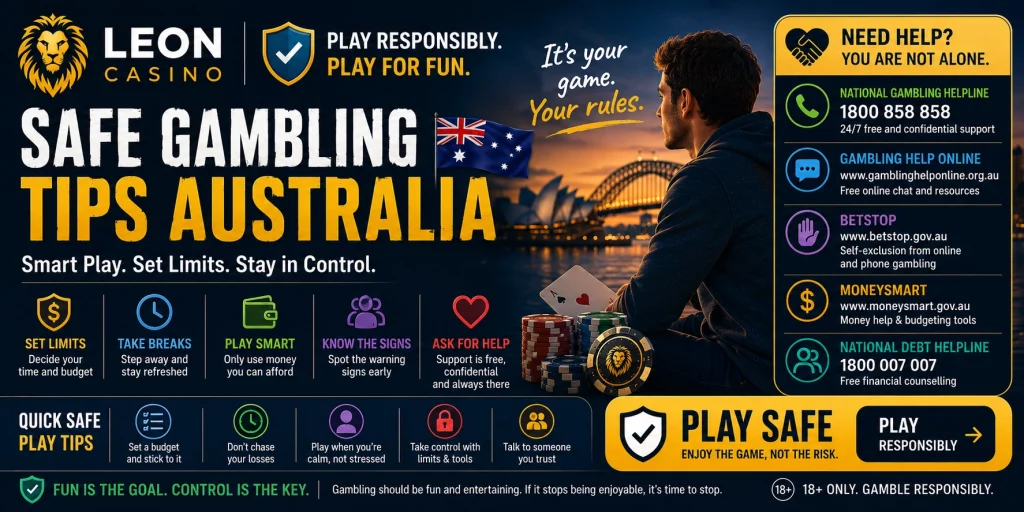
Safe gambling is not only about setting a budget. It is also about knowing when not to gamble. A person should not gamble when stressed, angry, tired, under financial pressure, trying to recover losses, or feeling emotionally dependent on the next result. If gambling starts to feel urgent or secretive, support should come before another session.
| Safe Gambling Principle | What It Means | Risk It Reduces | Practical Action |
|---|---|---|---|
| Use only disposable entertainment money | Never gamble with money needed for bills, food, rent, savings, family, or debt payments | Financial harm and chasing losses | Set a fixed budget before any session begins |
| Set time limits | Decide how long gambling can last before starting | Long, unfocused sessions | Use reminders and stop when the planned time ends |
| Avoid emotional gambling | Do not gamble to escape stress, boredom, anger, loneliness, or pressure | Impulsive decisions and repeated deposits | Pause and choose a non-gambling activity instead |
| Never chase losses | Do not continue playing to recover money already lost | Escalating financial loss | Stop immediately after reaching the planned limit |
| Use support early | Contact gambling support before harm becomes severe | Isolation, secrecy, and delayed action | Call 1800 858 858 or use Gambling Help Online |
Start With a Clear Personal Limit
A safe gambling routine should begin with a personal limit. This limit should include money, time, and emotional boundaries. A money limit answers the question: how much can be lost without affecting real life? A time limit answers: how long can this activity last before it becomes excessive? An emotional boundary answers: under what conditions should gambling not happen at all?
For Leon Casino readers, this matters because online gambling access can be fast. A person may move from the Login area to account activity very quickly, especially if passwords, payment methods, and device access are already saved. The faster the access, the more important the limit becomes.
A realistic limit should be conservative. It should not be based on hoped-for winnings or past lucky sessions. It should be based on what can be safely lost. If losing the full amount would create stress, regret, debt, or pressure to continue, the limit is too high.
Treat Bonuses With Caution
Promotions can make gambling feel more attractive, but they should never control a person’s budget. A Bonus offer may include wagering requirements, expiry periods, game restrictions, maximum bet rules, or withdrawal conditions. These terms can encourage longer play than originally planned.
A safe gambling approach means never depositing more because a promotion appears available. If a person would not make the same decision without the offer, the promotion is influencing behaviour too strongly. The safer choice is to review the terms calmly or skip the offer completely.
A bonus should never be used as a reason to recover losses. If a person is already frustrated after losing money, promotional play can increase risk by extending the session and keeping attention focused on gambling outcomes.
Safe Gambling Before Registration
A person should understand responsible gambling controls before account creation, not after problems appear. Before using any Sign up process, readers should know how deposit limits, cooling-off periods, self-exclusion, verification, withdrawal rules, and support options work.
This is important because account creation can create psychological commitment. Once a person has an account, promotional emails, saved details, and easier access may increase gambling exposure. Safe gambling means reviewing risk before joining any gambling environment.
For Australian readers, external support resources should also be known in advance. Gambling Help Online provides support and local service information for people affected by gambling, including family and friends. BetStop can block registered people from licensed Australian online and phone gambling providers and stop those providers from sending marketing messages.
Mobile Gambling and Device Control
Mobile access can increase gambling risk because it removes many natural barriers. A person can gamble from home, bed, public transport, work breaks, or late at night. The easier gambling becomes, the more important device control becomes.
Readers who use an App or mobile browser should be careful with notifications, saved passwords, fast deposits, and one-touch access. These features may be convenient, but convenience can become risky when gambling urges appear suddenly.
Safe mobile gambling means disabling promotional notifications, avoiding late-night access, removing shortcuts if gambling feels too frequent, and keeping the phone away during high-risk moments. If a person repeatedly opens gambling content without planning to, that is a warning sign.
Understand Game Speed and Risk
Different gambling formats carry different risk patterns. Fast games can create repeated decisions in a short period, making spending harder to track. Slower games can still become risky if the session lasts too long or if the player increases stakes after losses.
For people who browse Slots, speed is especially important. Slot rounds can move quickly, and small bets may become expensive when repeated many times. A person may feel that each spin is low-risk, but the total session cost can rise fast.
Safe gambling requires tracking total exposure, not only individual bet size. The question is not “Is this one bet small?” The better question is “How much have I spent in total, and am I still inside my original plan?”
Avoid Gambling as a Reaction to Stress
One of the most important safe gambling tips is to avoid gambling during emotional pressure. Stress, boredom, anger, loneliness, and disappointment can all weaken decision-making. Gambling during these states may feel like distraction, but it can quickly become a cycle.
A person should not gamble to change mood. Casino outcomes are uncertain, and uncertainty can make emotional pressure worse. A losing session may increase stress, while a winning session may encourage overconfidence and future risk.
A safer response is to pause, leave the gambling environment, and choose an activity that does not involve money risk. Walking, calling someone, eating, resting, or completing a normal task can interrupt the urge.
Use External Help Before Problems Escalate
Safe gambling also means knowing when external help is needed. If gambling becomes difficult to stop, if money is being hidden, if losses are being chased, or if gambling affects relationships, work, sleep, or study, support should be used immediately.
The National Gambling Helpline is listed by the Australian Government as free, confidential, and available 24/7. ACMA also points people who need help to the National Gambling Helpline and Gambling Help Online.
Seeking help is not a last resort. It is a practical safety step. Early support can prevent gambling harm from becoming more serious and can help the person decide whether limits, cooling-off, financial counselling, or self-exclusion are needed.
Safe Gambling Tips for Choosing Games
Game choice matters because different casino formats create different behaviour patterns. Some games are fast and repetitive. Others are slower but more immersive. Some rely almost completely on chance, while others include limited decision-making. Safe gambling means understanding these differences before play begins, not after the session has already become expensive or emotional.
For Leon Casino readers, the safest approach is to choose games based on entertainment value, not on imagined profit potential. A game should never be selected because it feels “due” to pay, because a previous result looked close, or because a player believes a streak can be predicted. Casino outcomes are uncertain, and responsible play requires accepting that uncertainty.
Players should also avoid switching between many games in an attempt to recover losses. Moving from one category to another can create the impression of a fresh start, but the same financial risk remains. Safe gambling means following one budget across the whole session, regardless of how many game types are opened.
| Game Behaviour | Possible Risk | Safe Gambling Tip | Best Player Action |
|---|---|---|---|
| Fast rounds with repeated betting | Spending may rise quickly without being noticed | Use shorter sessions and smaller stake sizes | Track total spend, not only single bets |
| High-volatility results | Long losing periods may encourage chasing | Set a strict loss limit before playing | Stop when the limit is reached |
| Large jackpot prizes | Players may overestimate the chance of winning | Treat jackpots as rare entertainment features | Never increase spending because of prize size |
| Live or immersive play | Sessions may last longer than planned | Use time reminders and scheduled breaks | Leave the table when the planned time ends |
| Promotional game restrictions | Terms may encourage extended wagering | Read rules before using any offer | Do not play only to complete requirements |
Keep One Budget for All Games
A common unsafe habit is creating separate mental budgets for different Games. A player may lose money on one category, then move to another and treat the second session as separate. In reality, the money comes from the same budget. Safe gambling requires one total limit for the entire day, week, or month.
For example, if a player decides that AUD 50 is the maximum weekly entertainment amount, that limit should apply across all casino activity. It should not reset when switching from slots to roulette, blackjack, live dealer games, or promotional features. A single budget gives a clearer view of total exposure.
This also helps prevent chasing. When the total limit is reached, the session ends. The player should not continue because another game “feels better” or because the previous game was unlucky. Safe gambling depends on stopping according to the plan, not according to emotion.
Read Rules Before Playing
Safe gambling includes understanding game rules. A player should know how a game works, what the betting range is, how rounds are settled, whether there are bonus features, and what the maximum risk per round can become. Playing without understanding rules can create unexpected losses.
Players should also read terms connected with promotions, tournaments, and special features. Terms may include eligible games, maximum bet sizes, wagering contribution rates, expiry times, and withdrawal limits. These details affect how a session works in practice.
If rules feel confusing, the safer decision is to pause. Gambling should not continue when the player does not understand the cost, pace, or conditions of play.
Use Time Breaks as a Safety Tool
Breaks are one of the simplest safe gambling tools, but they only work when used properly. A break should mean leaving the gambling screen, not just pausing a game while still watching the balance or lobby. The player should step away, check how they feel, and decide whether continuing still matches the original plan.
A useful routine is to take a break every 30 to 45 minutes. During the break, the player should ask three direct questions: how much time has passed, how much money has been used, and whether the session still feels calm. If any answer feels uncomfortable, the session should end.
Breaks are especially important during losing sessions. The urge to continue may become stronger when the player feels close to a recovery. That is the exact moment when stepping away is most useful.
Avoid Chasing Losses
Chasing losses is one of the most dangerous gambling behaviours. It happens when a player continues or increases gambling because they want to recover money already lost. The problem is that every new bet creates fresh risk. Previous losses do not make a future win more likely.
A safe gambling rule should be simple: lost money is not a reason to continue. Once the planned loss limit is reached, the session ends. The player should not change games, raise stakes, claim a new offer, or make another deposit.
Chasing can feel logical during emotional pressure, but it usually increases harm. A player may believe that one win will restore balance, but the next result is still uncertain. Safe gambling means accepting the loss limit as final.
Do Not Gamble With Borrowed Money
Borrowed money should never be used for gambling. This includes credit cards, loans, payday advances, money from friends, family support, or money intended for bills. Gambling with borrowed money creates pressure because the player is risking money that already belongs to someone else or must be repaid.
If a player feels tempted to borrow for gambling, that is a serious warning sign. The safest action is to stop immediately and contact support. Gambling should never become connected to debt.
For Australian readers, financial counselling can be helpful if gambling has already affected repayments, rent, utilities, savings, or household money. A financial counsellor can help create a repayment plan that does not rely on gambling outcomes.
Watch for Emotional Warning Signs
Safe gambling is not only about financial limits. Emotional warning signs are just as important. A player should pause if they feel restless, angry, guilty, desperate, overexcited, or unable to stop thinking about the next result.
Emotional gambling often appears after a loss, but it can also appear after a win. A big win may create overconfidence and encourage higher stakes. A losing session may create frustration and chasing. Both situations can lead to unsafe decisions.
Players should treat strong emotion as a signal to stop. Gambling decisions should be made when calm, not during pressure.
Separate Entertainment From Recovery
Gambling should never be used to recover money, mood, confidence, or control. Once gambling becomes a recovery tool, risk increases sharply. A person may begin playing not because they want entertainment, but because they feel something needs to be fixed.
This is especially dangerous after debt, family conflict, stress, or repeated losses. Casino play cannot provide stable recovery because the result is uncertain. It may briefly distract from stress, but it can also make stress worse.
A safer approach is to separate gambling from recovery completely. If money, mood, or relationships need repair, use practical support, budgeting, rest, communication, or professional help. Do not use gambling as the solution.
Safe Gambling Tips for Managing Payments
Payment control is one of the strongest safe gambling habits. A player may have good intentions before a session, but fast deposit access can weaken those intentions during emotional moments. Saved cards, quick wallet payments, and one-click deposits can make gambling too easy when the player is tired, frustrated, or chasing losses.
For Leon Casino readers, payment safety means setting clear limits before depositing and avoiding repeated transactions during the same session. A single planned deposit is easier to control than several smaller deposits made under pressure. Multiple small deposits can feel harmless individually, but together they may exceed the original budget.
Players should also avoid keeping gambling money mixed with essential funds. Rent, food, transport, bills, debt repayments, education costs, and family expenses should never be exposed to gambling risk. Safe gambling depends on separation: entertainment money is separate from real-life money.
| Payment Safety Tip | Why It Matters | Risky Behaviour | Safer Alternative |
|---|---|---|---|
| Use one planned deposit | Creates a clear session boundary | Making repeated top-ups after losses | Stop when the planned balance is gone |
| Remove saved payment details | Reduces impulsive deposits | Using one-click payments during frustration | Make every payment require a pause |
| Separate essential money | Protects bills and household needs | Depositing from the same account used for rent or bills | Use a fixed entertainment budget only |
| Avoid credit-funded gambling | Prevents debt pressure | Borrowing or using credit to continue play | Do not gamble if disposable money is unavailable |
| Review transactions weekly | Shows the true cost of gambling | Relying on memory after sessions | Track deposits, withdrawals, and net spend |
Check the Real Cost of a Session
A safe gambling session should be measured by total cost, not by single bets. A player may think a session is low-risk because individual bets are small, but repeated bets can build up quickly. This is especially true in fast-paced online games where many rounds can happen within a short time.
The real cost includes deposits, lost winnings, time spent, emotional stress, and any follow-up pressure to continue. If a player finishes a session and feels tense, guilty, or eager to deposit again, the session cost is higher than the financial number alone.
A useful habit is to write down the result after every session. The note can be simple: amount deposited, amount withdrawn, time spent, mood before playing, mood after playing, and whether the original plan was followed. This record helps reveal patterns that memory may hide.
Use Gambling Blocks and Self-Exclusion When Needed
Safe gambling includes knowing when ordinary limits are no longer enough. If a player repeatedly breaks their own rules, tries to recover losses, hides gambling, or feels unable to stop, stronger barriers are needed. These barriers may include self-exclusion, gambling blocks, bank restrictions, and external support.
BetStop is Australia’s national self-exclusion register for licensed online and phone wagering providers. Gambling Help Online and the National Gambling Helpline can also guide people toward appropriate support. These resources are important because willpower alone is often unreliable during strong urges.
Players should not wait for severe harm before using stronger controls. If gambling has started to feel difficult to manage, early blocking is safer than late reaction.
Safer Habits for Promotional Play
Promotional play can still carry risk. A player may think that free spins, cashback, or bonus funds reduce danger, but promotions often encourage longer sessions. They may also include wagering requirements, restricted games, and expiry periods that create pressure to continue.
A safe rule is to treat promotional funds as entertainment only. They should not justify larger deposits, longer play, or higher stakes. If a promotion makes the player feel rushed, it is better to ignore it.
Players should also avoid using offers after a losing session. A promotion that appears after losses can trigger the idea of recovery. Safe gambling means refusing offers when emotions are high.
Protecting Time and Attention
Time control is as important as money control. A person can stay inside a budget but still spend too many hours gambling. Long sessions can affect sleep, study, work, relationships, and mental clarity. For Australian players, time limits should be part of every gambling plan.
A safe session should have a start and end point. The player should decide in advance when to stop, then follow that decision even if the balance is changing. Stopping should not depend only on winning or losing.
If a player often loses track of time, session reminders should be used. If reminders are ignored repeatedly, the player should take a break from gambling and consider stronger controls.
Safe Gambling and Social Pressure
Sometimes gambling risk comes from social pressure. Friends, online communities, streamers, or promotional content can make gambling feel more normal or exciting than it really is. A player may feel encouraged to try new games, chase big wins, or compare results with others.
Safe gambling means making decisions independently. A player should not deposit because others are gambling, because someone shared a win, or because a streamer made a game look easy. Public wins are often more visible than losses, which can distort perception.
If gambling content makes a person want to deposit, it should be avoided. This includes streams, social media clips, casino forums, affiliate pages, and promotional communities.
Keep Support Information Easy to Reach
Support information should not be hidden until a crisis appears. A safe gambling routine includes keeping help details visible and easy to access. Players can save the National Gambling Helpline number, bookmark Gambling Help Online, and keep self-exclusion information available.
Helpful Links should point toward real support, not only casino pages. For Australian readers, useful resources include Gambling Help Online, BetStop, MoneySmart, and the National Debt Helpline. These services can help with gambling behaviour, access blocking, budgeting, and debt pressure.
If gambling starts to feel uncomfortable, support should be used before another deposit. A short conversation or online chat can interrupt an unsafe session and help the player choose a safer next step.
Review Gambling Behaviour Honestly
Honest review is one of the most useful safe gambling habits. A player should not only ask whether they won or lost. They should ask whether the session stayed controlled. Did they follow the budget? Did they stop on time? Did they chase losses? Did they feel pressure? Did gambling affect anything important?
If the answer is uncomfortable, the next session should not happen automatically. The player should reduce limits, take a break, use support, or consider self-exclusion. Repeating the same risky pattern while hoping for a different result is unsafe.
A monthly review can help players see whether gambling is becoming more frequent or expensive. If the pattern is increasing, action should be taken early.
Know When Safe Gambling Means Stopping
Safe gambling does not always mean continuing with better rules. Sometimes the safest choice is to stop completely. This is especially true when a player cannot follow limits, gambles with essential money, hides activity, borrows to play, or feels anxious without gambling.
Stopping can include self-exclusion, blocking tools, financial counselling, and support conversations. It can also include telling one trusted person and removing gambling content from devices.
A person should not see stopping as failure. It is a responsible decision when gambling is no longer controlled entertainment.
Building a Safer Long-Term Routine
Long-term safe gambling depends on routine. Players should set limits, avoid emotional sessions, protect money, take breaks, and review behaviour consistently. These habits should not disappear after one good week. Responsible gambling is ongoing.
For Leon Casino readers in Australia, the strongest approach is conservative and simple: gamble only with disposable entertainment money, never chase losses, avoid gambling under stress, use account controls, and contact support early.
The safer the routine, the less gambling depends on impulse. Good boundaries protect money, time, mental wellbeing, and personal relationships.
Safe Gambling Tips for Long-Term Player Control
Safe gambling is strongest when it becomes a long-term habit rather than a one-time decision. A player may set limits once, follow them for a few sessions, and then slowly loosen them when gambling feels normal again. This is where risk can return. Responsible play requires regular review, stable boundaries, and the willingness to stop when gambling begins to feel pressured.
For Leon Casino readers in Australia, long-term control should include budget planning, time management, emotional awareness, account tools, and external support options. These elements work best together. A budget without time control may still lead to long sessions. A time limit without financial control may still allow repeated deposits. A support page without personal action may not reduce risk.
Safe gambling is not about trying to eliminate all risk while continuing exactly the same behaviour. It is about changing the structure around gambling so that money, time, and decisions stay protected. The player should always know how much they can spend, how long they can play, when they must stop, and where to get help if gambling starts to feel uncomfortable.
| Long-Term Safety Area | Responsible Habit | Warning Sign | Safer Response |
|---|---|---|---|
| Budget | Keep gambling money separate from essential funds | Using bill money, savings, or credit | Stop gambling and contact financial support |
| Time | Use fixed session times and regular breaks | Losing track of hours or playing late at night | Set shorter sessions or take a cooling-off period |
| Emotion | Only gamble when calm and clear-headed | Playing while stressed, angry, bored, or desperate | Leave the session and choose a non-gambling activity |
| Account Control | Use limits, reminders, and self-exclusion when needed | Trying to bypass or increase limits frequently | Reduce limits or use stronger exclusion tools |
| Support | Keep help services easy to access | Hiding gambling or avoiding conversations | Contact Gambling Help Online or the National Gambling Helpline |
Understand That Wins Can Also Increase Risk
Many safe gambling discussions focus on losses, but wins can also create risky behaviour. After winning, a player may feel confident, increase stakes, extend the session, or believe they are playing with “extra” money. This can turn a positive result into a longer and riskier session.
A win should not change the original plan. If the player planned to stop after 45 minutes, the session should end after 45 minutes. If the player planned to use one deposit only, there should be no additional deposit because the balance changed. Safe gambling means the plan controls the session, not the outcome.
Players should also avoid treating winnings as proof of skill or prediction. Casino results include chance, and a successful session does not guarantee future results. The safest response to a win is to stop, withdraw where appropriate, and avoid raising risk because of temporary confidence.
Avoid Gambling Myths
Gambling myths can lead to unsafe decisions. Some players believe that a game is “due” to pay, that a losing streak must soon reverse, or that changing stake size can force a better result. These beliefs can encourage chasing and longer sessions.
Safe gambling requires rejecting these assumptions. Previous outcomes do not create a guaranteed future win. A near miss is not evidence that a prize is close. A larger bet does not make the game safer. A promotion does not remove the risk of loss.
Players should also be careful with online discussions that present gambling systems as reliable. No betting pattern can remove the house advantage from casino gambling. A system that encourages higher stakes after losses can be especially dangerous.
Keep Gambling Separate From Identity
Gambling should never become part of a person’s identity, self-worth, or daily routine. A player should not feel that they are a “good player” because they win or a “bad player” because they lose. This kind of thinking can make gambling emotionally heavier than it should be.
Safe gambling treats casino play as optional entertainment. It is not a measure of intelligence, courage, patience, or discipline. A person who stops after reaching a limit is not weak. They are following the safest decision.
This mindset matters because gambling can become personal when losses happen. A player may want to prove they can recover or show they can make better choices. That pressure can lead to unsafe play. The safer approach is to step away and protect the original boundary.
Use Cooling-Off Periods Before Risk Escalates
Cooling-off periods should be used before gambling becomes severe. A cooling-off period gives the player distance from the account and reduces the chance of impulsive decisions. It is useful after losing sessions, emotional play, repeated deposits, or any moment when gambling starts to feel difficult to stop.
Some players wait too long before taking a break. They may think cooling-off is only necessary after major harm. In reality, it is most useful earlier. A short break can interrupt a developing pattern before it becomes harder to control.
For Leon Casino readers, cooling-off should be seen as a normal responsible gambling tool. It is not a punishment. It is a protective pause that allows the player to review behaviour without immediate access to gambling.
Protect Sleep and Daily Routine
Sleep is often affected when gambling sessions extend into the night. Late-night gambling can be risky because decision-making is weaker, emotions may be stronger, and fewer people are available for support. A session that begins casually can continue for hours when the player is tired and alone.
A safe gambling rule is to avoid gambling when tired. Players should also avoid gambling in bed or during times normally reserved for rest. If gambling interferes with sleep, it has already moved beyond simple entertainment.
Daily routine should remain protected. Work, study, family time, exercise, meals, and sleep should never be moved around gambling. If gambling starts taking priority over normal life, the player should stop and use support.
Safe Gambling Review Checklist
A review checklist helps players decide whether gambling is still controlled. This should be done regularly, especially after sessions that felt intense, expensive, or emotionally uncomfortable. The checklist should focus on behaviour, not only financial outcome.
A player can ask:
- Did I stay within my planned budget?
- Did I stop at the planned time?
- Did I gamble while stressed or emotional?
- Did I chase losses?
- Did I make extra deposits?
- Did I hide the session from anyone?
- Did gambling affect sleep, work, study, or relationships?
- Did I feel calm after stopping?
If several answers are concerning, the next step should not be another session. The safer response is to reduce limits, take a break, contact support, or consider self-exclusion.
When Responsible Play Means Taking a Longer Break
A longer break may be needed when gambling becomes repetitive, stressful, or difficult to control. This can happen even if the person has not experienced major financial harm. Emotional discomfort is enough reason to pause.
A player should consider a longer break if they think about gambling often, feel restless without it, return after promising to stop, or feel pressure to recover previous losses. A longer break may also be useful after major life stress, income changes, debt pressure, or family conflict.
During the break, the player should remove gambling triggers. This may include blocking websites, unsubscribing from emails, deleting shortcuts, disabling notifications, and avoiding gambling content. The break should create real distance, not just a temporary promise.
Support for Family Members
Safe gambling information should include family members because gambling harm often affects households. Partners, parents, and friends may notice changes before the player does. They may see hidden spending, mood changes, late-night device use, or repeated financial stress.
Family members can contact gambling support services for guidance. They can learn how to talk about the issue, protect shared finances, and avoid enabling harmful patterns. This support can reduce conflict and help the player access help earlier.
A player who feels worried about how family will react can also speak with a support service first. Counsellors can help plan the conversation and reduce shame or confusion.
Safer Gambling Is Built on Clear Decisions
The safest gambling decisions are made before play begins. Once a session is active, emotion and momentum can make decisions harder. This is why safe gambling depends on preparation: set the budget, set the time, decide stop rules, check emotional state, and know where support is.
A strong stop rule is specific. “I will stop if I lose too much” is vague. “I will stop after AUD 40 or 45 minutes, whichever comes first” is clearer. Clear rules are easier to follow.
Players should also decide what happens after the session. A safe routine might include logging out, recording the result, taking a break from the device, and not returning the same day.
Final Safe Gambling Guidance for Australian Players
Safe gambling is not passive. It requires active control over money, time, emotions, devices, promotions, and access. For Leon Casino readers in Australia, the safest approach is to keep gambling limited, planned, and secondary to real life.
The key rules are direct: use only disposable entertainment money, set limits before play, never chase losses, avoid gambling under stress, take breaks, read terms carefully, protect payment access, and contact support early if gambling feels uncomfortable.
If gambling remains calm, limited, and optional, responsible habits can help maintain control. If gambling becomes stressful, secretive, financially harmful, or difficult to stop, the safest decision is to stop playing and use professional support. Safe gambling means protecting wellbeing first.






Comments