
How Safe Are Online Casinos Australia
How Safe Are Online Casinos Australia: What Players Need to Know
Online casino safety in Australia is not a simple yes-or-no question. A platform can look polished, offer a smooth mobile layout, show familiar payment logos, and still create serious risks if its legal status, payment rules, privacy controls, and responsible gambling tools are weak. For Australian readers, the safest starting point is not the design of the site. It is whether the service is legally allowed to target people in Australia and whether it provides clear consumer protections.
This matters because Australia treats online gambling services differently depending on the product type. Licensed online wagering is one category. Online casino-style gambling is another. The Australian Communications and Media Authority, known as ACMA, explains that some online gambling services are prohibited when offered to customers in Australia, including online casinos and online slot machines. That means the question “How safe are online casinos Australia?” must begin with legality before discussing entertainment, payment speed, game variety, or mobile access.
For Leon Casino, a responsible page on this topic should be built as a safety guide rather than a promotional page. It should help readers understand what to check before trusting any gambling-related website with money, identity documents, or personal data. It should also explain that gambling can create financial and emotional harm, especially when a person chases losses, uses essential money, hides activity, or treats gambling as a way to solve financial pressure.
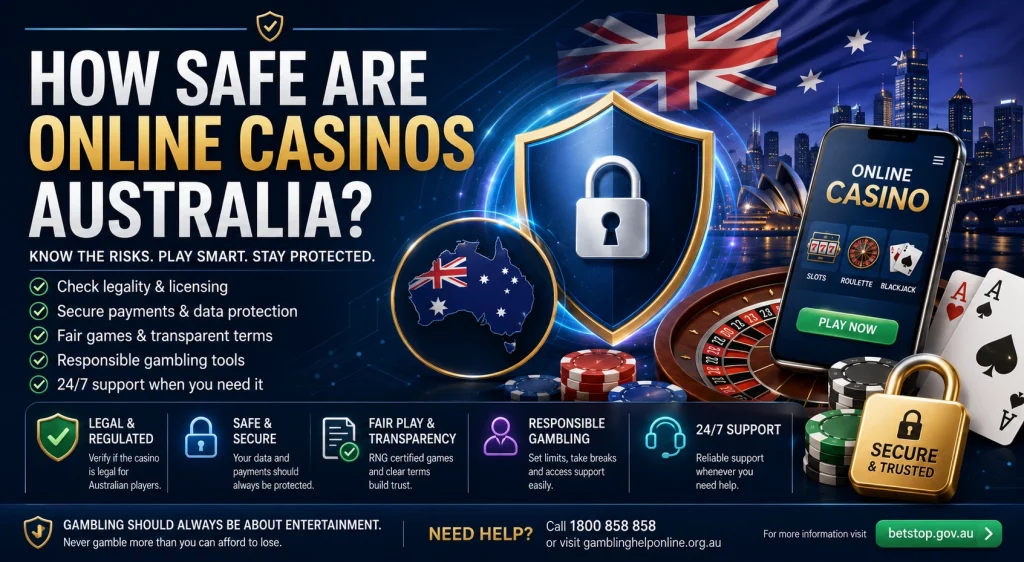
A safe gambling environment has several layers. The first layer is legal clarity. The second layer is transparent ownership. The third layer is payment fairness. The fourth layer is data protection. The fifth layer is responsible gambling support. If one layer is missing, the risk increases. If several are missing, the platform should be treated as unsafe regardless of how professional it looks.
Legal Safety Comes Before Casino Design
Many people judge online casinos by what they can see first: homepage design, game thumbnails, loading speed, mobile layout, live chat, or welcome messages. These details may influence usability, but they do not prove safety. A strong visual design can hide weak legal standing. A familiar-looking payment icon can hide unclear withdrawal conditions. A large game library can hide the fact that the platform is not operating within Australian rules.
Legal status should always be the first safety filter. Australian users should check whether a gambling-related service is permitted for the Australian market. If a website is offshore, vague about licensing, or uses broad phrases such as “internationally licensed” without clear jurisdictional detail, that is not enough. A foreign licence does not automatically mean that a service is legal for Australians.
ACMA also maintains information about blocked gambling websites. A blocked or repeatedly reappearing gambling domain is a serious warning sign. It suggests that the operator may be breaching Australian rules or offering prohibited services to Australian customers. In this context, safety is not only about whether a user can open the website. It is about whether the operator is accountable under relevant Australian protections.
A responsible Australian-facing page should therefore avoid treating offshore access as normal or risk-free. It should explain that legal uncertainty is itself a safety problem. If a reader cannot verify the operator, the licence, the complaint route, and the applicable law, they should not treat the platform as safe.
Online Casino Safety Checklist for Australian Readers
| Safety Area | What to Check | Why It Matters | Official Resource |
|---|---|---|---|
| Legal status | Check whether the gambling service is legally allowed to offer its product to people in Australia. | Illegal or prohibited services may not provide Australian-standard consumer protections. | ACMA Online Gambling Services |
| Blocked website risk | Look for warning signs that the platform or similar domains have been blocked or investigated. | Website blocking can indicate breach of Australian online gambling rules. | ACMA Blocked Gambling Websites |
| Consumer protection | Review ownership, licence details, complaint procedures, and payment rules before any account activity. | Users need a clear path if withdrawals, verification, privacy, or account restrictions become disputed. | ACMA Compliance and Investigations |
| Gambling harm support | Check whether the site gives visible access to support, time-outs, account limits, and self-exclusion information. | Responsible gambling tools should be easy to find before harm escalates. | Gambling Help Online |
| Privacy and personal data | Check how identity documents, payment details, device data, and personal information are stored and shared. | Weak privacy practices can expose users to identity misuse and financial risk. | OAIC Privacy Information |
How Leon Casino Should Explain Safety
For Leon Casino, a page about online casino safety in Australia should not rely on generic phrases such as “safe and secure” without explaining what those words mean. Safety should be broken into practical checks. A reader should understand how legality works, why offshore casino-style gambling can be risky, how to review terms, how to protect personal data, and where to get help if gambling becomes difficult to control.
The Login area should be presented as an account-access point, not as a reason to gamble frequently. The Bonus section should be explained with caution because promotional terms can sometimes create misunderstanding around wagering rules, expiry dates, and withdrawal conditions. The Sign up process should be connected with age checks, identity verification, and responsible gambling information. An App may offer convenience, but convenience can also increase risk if alerts, deposits, and session time are not controlled. Slots and rapid-play products require extra caution because repeated outcomes can make spending feel less visible. Games should be described as chance-based entertainment with financial risk, not as a way to earn money. The FAQ should answer questions about payments, limits, verification, complaints, and safer gambling tools. Responsible Links should direct readers to official Australian resources, not only commercial pages.
This type of internal structure helps the page answer search intent without becoming unsafe or overly promotional. It also keeps the content aligned with Australian consumer-protection concerns. A reader should leave the page with clearer judgement, not with pressure to register, deposit, or continue gambling.
Online Casino Safety Layers
Why Offshore Online Casinos Can Be Riskier
Offshore online casinos can create several safety problems for Australian readers. The first is legal uncertainty. A site may hold a licence somewhere else, but that does not automatically make it legal to offer prohibited online casino-style services to people in Australia. If the platform is not clearly permitted for Australian users, the safest interpretation is that risk is high.
The second issue is weak complaint resolution. If a user has a withdrawal dispute, account restriction, verification delay, or privacy concern, it may be difficult to enforce a complaint across jurisdictions. A local Australian pathway may not apply if the operator is not legally serving the Australian market. This can leave the user dependent on the operator’s own support process, which may not be independent.
The third issue is responsible gambling coverage. Australian self-exclusion and harm-minimisation tools may not work properly with overseas platforms. If a person is trying to stop gambling, a platform that ignores exclusion requests, continues marketing, or makes account closure difficult can increase harm. Safety is not only about encryption or payment logos. It is also about whether the operator helps users stop when gambling becomes risky.
The fourth issue is data exposure. Offshore gambling sites may request identity documents, card details, bank information, wallet data, or proof of address. If privacy rules are unclear, the user may have limited protection if data is mishandled. For this reason, Australian readers should avoid uploading sensitive documents to any platform that cannot clearly explain its company identity, privacy policy, storage rules, and complaint process.
Security Signals That Matter More Than Casino Branding
Online casino safety in Australia should be judged through verifiable security signals, not through branding, homepage design, or promotional wording. A site can look polished and still present serious risks around legality, payments, privacy, identity documents, and gambling harm. For Australian readers, the first safety question is whether the service is legal for the Australian market, because ACMA explains that the Interactive Gambling Act makes it illegal for gambling providers to offer some online services to people in Australia.
Security begins with transparency. A safer gambling-related website should clearly identify the operator, licensing details, applicable jurisdiction, terms, privacy policy, complaints process, payment rules, and responsible gambling tools. If a website hides company information, uses vague licence claims, or offers no practical complaint pathway, that is a significant warning sign. A responsible reader should be able to check the platform before sharing money, identity documents, or payment data.
Data protection is another central safety issue. Gambling-related platforms may request sensitive information, including full name, address, date of birth, phone number, proof of identity, and payment details. This information should never be treated casually. A weak privacy policy, unclear document-storage practice, or unexplained third-party sharing can expose users to identity and financial risk. If a site asks for sensitive data but gives little explanation of how that data is protected, the safety standard is weak.
Payment safety also requires close attention. A reliable platform should explain deposit methods, withdrawal conditions, verification checks, processing times, account restrictions, fees, and dispute steps in plain language. Payment safety is not only about quick deposits. It is about whether withdrawals are fair, predictable, and not blocked by hidden rules. If the terms are scattered across several pages or written in confusing language, the user should treat that as a risk signal.
Legal Status, Blocking, and Consumer Protection
Australia’s online gambling framework makes legal status a core safety factor. ACMA states that its online gambling information helps users protect themselves from illegal gambling operators and check whether a betting service is on the register of licensed interactive wagering providers. It also notes that from 11 June 2024, credit cards and digital currency cannot be used to place bets with licensed online wagering providers.
Website blocking is another important signal. ACMA publishes information about blocked gambling websites and explains that blocking is used against services found to be operating in breach of Australian online gambling rules. A blocked or frequently reappearing domain should not be treated as a normal entertainment option. It should be viewed as a serious warning sign that the operator may not meet Australian consumer-protection expectations.
A foreign licence does not automatically solve this problem. Some offshore operators may claim to be licensed in another jurisdiction, but that does not necessarily make their services legal for Australians. A user may still face weak complaint rights, poor payment protection, limited privacy recourse, and no reliable local dispute pathway. For this reason, an Australian-facing safety review should judge the platform according to Australian relevance, not only according to offshore licence badges.
For Leon Casino, this section should be factual and cautious. The page should not encourage readers to ignore legal uncertainty. It should explain that legality, transparency, and user protection come first. When a platform’s legal position is unclear, the safest interpretation is that the risk is high.
| Safety Check | Low-Risk Signal | High-Risk Signal | Why It Matters |
|---|---|---|---|
| Legal availability | The service is clearly permitted for the Australian market and provides verifiable regulatory information. | The site targets Australians while relying on vague offshore licensing claims. | Illegal or unclear services may not provide Australian-standard consumer protections. |
| Operator identity | The company name, registered address, licence details, and complaint route are easy to find. | Ownership information is hidden, incomplete, or replaced with broad marketing claims. | Transparent ownership makes accountability easier when payments or documents become disputed. |
| Payment terms | Deposits, withdrawals, fees, verification, and processing times are explained before account use. | Withdrawals depend on unclear conditions, changing checks, or confusing promotional rules. | Payment opacity is one of the clearest operational risk signals. |
| Privacy policy | The site explains how identity documents, payment data, and personal information are collected and protected. | The site requests sensitive information without clear storage, sharing, or retention rules. | Weak privacy practices can expose users to identity misuse or data risk. |
| Responsible gambling tools | Limits, time-outs, self-exclusion, account closure, and support contacts are visible and simple to use. | Tools are hidden, slow, incomplete, or difficult to activate. | Harm-prevention tools are essential safety features, not optional extras. |
Responsible Gambling Tools as a Safety Test
A gambling-related platform cannot be considered safety-focused if responsible gambling controls are difficult to find or difficult to use. These controls include deposit limits, time-outs, account closure, self-exclusion, spending reminders, session reminders, and support contacts. Their purpose is to create friction before gambling behaviour becomes harmful. If the tools are hidden in small print or require long support conversations, the platform’s safety standard is weaker.
BetStop is especially relevant for Australian users. It is the National Self-Exclusion Register, a free Australian Government initiative that allows a person to block themselves from all licensed Australian online and phone gambling providers. Once registered, covered providers cannot let the person place bets, open new betting accounts, or receive marketing messages.
However, self-exclusion should be understood accurately. BetStop applies to licensed Australian online and phone gambling providers. It is not a universal shield against every gambling risk, every offshore website, or every venue-based gambling environment. Gambling Help Online explains that people can also seek help with venue self-exclusion and access the Gambling Helpline, which is free, confidential, and available 24 hours a day, 7 days a week.
A responsible safety page should present these tools as normal protective measures. They are not signs of failure. They are practical controls for people who want to reduce exposure, stop gambling, or protect themselves before harm becomes severe. If gambling is affecting money, sleep, relationships, study, work, honesty, or mood, support is already relevant.
Payment Methods and Financial Risk
Payment systems are often presented as convenience features, but they are also safety indicators. Fast deposits can increase risk if they are not balanced by strong spending limits and clear transaction visibility. A safer environment should make it easy to review total spending, set limits, pause activity, and stop quickly. It should not create pressure to deposit again after losses.
Australian rules around licensed online wagering also show why payment controls matter. ACMA’s online gambling information explains that credit cards and digital currency cannot be used to place bets from 11 June 2024. This is relevant because gambling with borrowed funds or difficult-to-trace digital assets can increase financial harm.
For offshore casino-style websites, payment risk can be more complex. Some platforms may push alternative payment channels, wallet transfers, crypto-style deposits, or payment routes that are harder to dispute. This can make refunds less reliable and spending less visible in ordinary bank statements. A platform that encourages difficult-to-reverse payments should be treated with caution.
Financial safety also depends on personal boundaries. Gambling money should never come from rent, food, bills, transport, debt repayments, education costs, emergency savings, family money, or borrowed funds. If gambling requires credit, secrecy, or repayment planning, it has moved beyond entertainment and into financial risk.
Privacy, Verification, and Identity Documents
Identity verification can be legitimate when used for age checks, fraud prevention, anti-money-laundering controls, and account security. The problem is not verification itself. The problem is unclear verification. A user should know why documents are required, when they are required, how long they are stored, and whether they are shared with third-party providers.
A site that asks for documents only at withdrawal stage can create frustration and distrust, especially if the requirements were not explained before deposits. A safer process explains verification early and avoids unnecessary repeated requests. Poor verification handling is often connected to withdrawal disputes, locked accounts, and repeated complaints.
Privacy risk is wider than identity documents. Marketing permissions, cookies, tracking pixels, analytics tools, payment processors, device data, and third-party sharing can all affect user privacy. If a gambling-related website cannot explain its data practices clearly, it should not be treated as trustworthy.
For Australian readers, the safest approach is conservative. Do not provide sensitive documents to unclear operators. Do not use platforms with vague privacy terms. Do not assume that an offshore service applies Australian privacy expectations. If the operator cannot clearly explain how it protects personal and financial data, the platform fails an important safety test.
Practical Guidance for Evaluating Safety
The practical answer to “How safe are online casinos in Australia?” is conditional. They are not automatically safe because they have a modern interface, large game catalogue, or mobile access. Safety depends on whether the platform is legal for Australian users, transparent about ownership, fair in payment terms, protective with data, and serious about gambling-harm prevention.
Readers should also pay attention to the frequency and communication of system updates. Regular updates to game libraries, payment systems, and security protocols can indicate active maintenance and risk management. Platforms that rarely update or provide minimal change information may be at higher operational risk, especially if technical issues, payment changes, or regulatory adjustments occur. Monitoring update transparency can therefore serve as an early signal of platform reliability.
Finally, a comprehensive evaluation includes user feedback trends. Individual complaints do not always prove a systemic issue, but recurring patterns such as delayed withdrawals, unclear promotional terms, repeated verification errors, or ignored support requests can highlight structural weaknesses. Combining personal caution with independent review helps readers assess platforms more realistically while keeping safety and harm prevention at the centre.
Red Flags That Make an Online Casino Unsafe
A safe-looking online casino page can still contain serious warning signs. These signs are not always obvious on the homepage. Many appear in the terms, withdrawal policy, privacy policy, support process, verification rules, or ownership details. For Australian readers, this matters because the Interactive Gambling Act makes it illegal to provide some interactive gambling activities, including online casinos and online pokies, to someone physically in Australia.
One major red flag is unclear ownership. If a website does not clearly show the operating company, licence details, jurisdiction, complaints route, and privacy responsibilities, the user has little practical accountability if something goes wrong. A vague footer, generic licence badge, or unsupported “trusted worldwide” claim is not enough. Real safety requires traceable information.
Another warning sign is pressure-based design. Some gambling websites use countdowns, urgent banners, constant pop-ups, or repeated payment prompts to push fast decisions. These tactics are risky because gambling-related decisions should be slow, limited, and financially conscious. Any platform that makes it difficult to pause, review terms, or leave the site should be treated with caution.
Withdrawal friction is also important. A platform may accept money quickly but delay withdrawals through repeated document requests, unclear promotional conditions, unexpected account reviews, or changing limits. Verification can be legitimate, but it should be explained clearly before any money or identity documents are involved. If the rules become visible only after a withdrawal request, the safety standard is weak.
| Unsafe Signal | What It Looks Like | Why It Is Risky | Safer Interpretation |
|---|---|---|---|
| Unclear ownership | The website does not clearly identify the company, jurisdiction, licence, or complaints process. | Users may have limited accountability if payments, documents, or account access become disputed. | Treat the platform as high risk until ownership and legal status are independently clear. |
| Pressure design | Countdowns, urgent banners, repeated prompts, or messages that push fast payment decisions. | Pressure can weaken judgement and encourage impulsive gambling behaviour. | Do not make gambling-related decisions under urgency, stress, or emotional pressure. |
| Hidden withdrawal rules | Withdrawal conditions appear only after account creation, payment activity, or identity checks. | Users may be unable to access funds as expected or may face unexpected restrictions. | Financial terms should be clear before any account or payment activity. |
| Weak responsible gambling tools | Limits, time-outs, self-exclusion, or account closure options are difficult to find or slow to activate. | Missing friction can increase harm when a person is trying to stop or reduce gambling. | Harm-prevention tools should be visible, immediate, and easy to use. |
| Unclear data handling | The site requests ID, payment details, or proof of address without explaining storage and use. | Identity documents and financial data can create privacy and fraud risks if poorly handled. | Do not provide sensitive documents to operators with vague privacy practices. |
Fair Terms Are a Core Safety Feature
Fair terms are not small print. They are one of the strongest indicators of online casino safety. A website that treats terms as a legal trap rather than a clear user guide is not operating in a user-protective way. For Australian readers, fair terms should explain account rules, identity checks, payment limits, restricted services, complaint options, and responsible gambling controls in direct language.
Promotional terms deserve particular caution. A short offer may be attached to long conditions involving wagering requirements, maximum cashout limits, product contribution rules, expiry dates, identity checks, and withdrawal exclusions. A safer page explains these conditions clearly before any user action. An unsafe page hides them behind small links, unclear wording, or several separate documents.
Fair terms should also explain account suspension and closure. A user should know when an account can be restricted, what happens to remaining balances, how disputes are reviewed, and how self-exclusion differs from ordinary account closure. If a platform can close, freeze, or delay accounts without a clear process, users face avoidable operational risk.
The safest approach is to read terms as risk information, not routine website text. If the terms are confusing, incomplete, or inconsistent, that confusion itself is a safety problem.
Privacy and Identity Verification Risks
Privacy is one of the most overlooked parts of online casino safety. Gambling-related websites may collect personal information such as name, address, date of birth, phone number, payment details, IP address, device data, and identity documents. The OAIC explains that personal information can include details such as a person’s name, address, date of birth, photographs, IP addresses, and location information from mobile devices.
Identity verification can be necessary for age checks and fraud prevention, but it must be handled carefully. A safe process tells users what documents are needed, why they are needed, how long they are stored, and whether they are shared with third-party verification providers. A weak process asks for documents without giving clear privacy information.
The OAIC’s Australian Privacy Principles provide the framework for how covered organisations and agencies must handle personal information, and a breach of those principles can lead to regulatory action and penalties. This matters because identity documents, payment details, and account records can create serious privacy risk if they are collected or stored poorly.
Australian readers should treat privacy as part of financial safety. A payment dispute is one risk. Identity misuse is another. If a website cannot explain how it protects documents, payment information, and account data, it should not be considered safe.
Safe vs Unsafe Platform Signals
Complaints, Support, and Accountability
A safe platform should explain how complaints are handled. This includes payment disputes, account restrictions, verification delays, privacy concerns, and responsible gambling requests. If a user cannot find a complaint process before sharing money or personal information, that is a poor sign. Accountability should not begin only after something goes wrong.
ACMA publishes information about investigations into online gambling providers, including examples of prohibited interactive gambling services and unlicensed regulated interactive gambling services. This reinforces the point that gambling legality is not a casual detail. It is a core consumer-protection issue.
Support access is also part of safety. Gambling Help Online describes itself as free online support for anyone affected by gambling, available 24/7 across Australia. This type of support should be easy to find on any responsible gambling information page, especially when the content discusses risk, legality, and harm prevention.
Good complaint and support design should be simple: clear contact routes, realistic response times, written confirmation, escalation paths, self-exclusion instructions, and independent support resources. If these are missing, the platform is weaker from a safety perspective.
Safer Reading of Reviews and User Feedback
Reviews can help identify safety patterns, but they must be read carefully. A single negative review does not prove that a platform is unsafe. A single positive review does not prove that it is safe. What matters is repetition. If many users report delayed withdrawals, unclear identity checks, locked accounts, poor support responses, or confusing terms, that pattern deserves attention.
Readers should also separate emotional reviews from operational evidence. A complaint about losing money is not the same as a complaint about withheld withdrawals or ignored self-exclusion. Gambling always carries the risk of losing money. Operational safety is about whether the platform follows clear rules, handles payments fairly, protects data, and respects harm-prevention controls.
Positive reviews should also be questioned if they focus only on design, promotions, or entertainment. A useful safety review should discuss legal status, terms, payment handling, verification, privacy, support, complaints, and responsible gambling tools. Anything less is incomplete.
For Australian readers, the safest conclusion is conservative. If a platform has uncertain legality, vague ownership, unclear payment rules, weak privacy statements, and poor support feedback, it should be treated as unsafe regardless of how polished it looks.
Final Safety Verdict for Australian Readers
The safest answer to “How safe are online casinos in Australia?” is conditional. Online casino safety depends on legal status, transparent ownership, payment rules, privacy practices, responsible gambling controls, and the reader’s own ability to stop without pressure. A platform may look professional, but appearance does not prove compliance, fairness, or user protection.
For Australian readers, legality remains the first filter. ACMA advises people to use gambling services that are legal in Australia and to check whether a betting service appears on the register of licensed interactive wagering providers. ACMA also states that from 11 June 2024, credit cards and digital currency cannot be used to place bets with licensed online and telephone wagering operators. These rules show that safety is not only a private user decision; it is also a regulatory issue connected with consumer protection and harm reduction.
A website should not be treated as safe only because it has a modern homepage, fast loading speed, a mobile interface, or familiar-looking payment icons. Those features may improve usability, but they do not prove that the operator is accountable. Real safety requires clear legal status, understandable terms, strong data handling, fair withdrawal rules, visible support options, and working self-exclusion tools.
The same applies to promotional language. A platform that focuses heavily on urgency, limited-time offers, or repeated payment prompts may increase risk for users who are already vulnerable to impulsive decisions. A responsible gambling-related page should slow the reader down. It should encourage checking, reading, comparing official information, and stopping when something is unclear.
Online Casino Safety Scorecard
| Review Area | Strong Safety Standard | Unsafe or Weak Standard | Recommended Reader Response |
|---|---|---|---|
| Legal status | The platform gives clear, verifiable information about whether its services are legal for Australian users. | The site relies on vague offshore licence claims, mirror domains, or unclear jurisdictional wording. | Do not rely on design or marketing. Check official Australian regulatory information first. |
| Ownership transparency | The company name, registered address, licence details, and complaint process are easy to find. | The operator hides ownership, gives only a contact form, or avoids clear accountability. | Treat unclear ownership as a major warning sign. |
| Payments and withdrawals | Deposits, withdrawals, fees, limits, verification, and processing times are explained before payment activity. | Deposits are easy, but withdrawals depend on unclear bonus rules, repeated checks, or changing conditions. | Never share money where withdrawal rules are unclear or incomplete. |
| Privacy and documents | The platform explains how identity documents, payment data, device data, and personal information are stored and protected. | The site asks for sensitive documents without clear storage, retention, or third-party processing details. | Do not upload documents to operators with vague privacy practices. |
| Responsible gambling tools | Limits, time-outs, self-exclusion, account closure, and support contacts are visible before account activity. | Safety tools are hidden, slow, incomplete, or handled only through delayed support replies. | Use protective tools early. If they are difficult to activate, the platform is not safety-focused. |
| Support quality | Support gives clear written answers about terms, payments, verification, complaints, and account restrictions. | Support avoids direct answers, repeats scripts, or refuses to explain decisions clearly. | Keep records of communication and avoid platforms with repeated unresolved complaints. |
Self-Exclusion and Blocking Tools in Australia
Self-exclusion is one of the most important safety tools because it creates a practical barrier when gambling becomes difficult to control. BetStop is the National Self-Exclusion Register, a free Australian Government initiative that allows people to block themselves from all licensed Australian online and phone gambling providers. Once registered, covered providers must not let the person place bets, open new betting accounts, or receive marketing messages.
This tool is important, but it should be understood accurately. BetStop applies to licensed Australian online and phone wagering providers. It is not a universal block against every offshore website, every illegal gambling domain, or every venue-based gambling environment. This is why legal status still matters. A platform outside Australian safeguards may not respect the same protections.
For venue-based gambling and broader harm support, Gambling Help Online explains that self-exclusion can help people block or bar themselves from gambling venues. The service also states that people can contact the Gambling Helpline on 1800 858 858 for free, confidential support 24 hours a day, 7 days a week.
A responsible safety page should present self-exclusion as a normal risk-management tool, not as a last resort. If gambling is affecting money, sleep, honesty, relationships, work, study, or mood, the right time to use protective tools is now, not after serious damage has already occurred.
How to Make a Safer Decision Before Sharing Data or Money
Before sharing personal information, identity documents, or payment details, Australian readers should pause and examine the operator carefully. The key question is not whether the website looks modern. The question is whether the reader can identify the company, understand the legal status, read the financial rules, find the privacy policy, and access support without pressure.
A safer decision begins with slow reading. Terms and privacy pages should be reviewed before account creation. Payment conditions should be checked before any deposit. Verification requirements should be understood before documents are uploaded. Responsible gambling tools should be visible before gambling begins. If any of these steps feels hidden, rushed, or confusing, that is a sign to stop.
Readers should also avoid emotional decisions. Gambling-related websites may use urgency, bright banners, countdowns, or promotional wording to create speed. Safety requires the opposite: time, clarity, and distance. No gambling-related decision should be made while stressed, tired, angry, lonely, intoxicated, or under financial pressure.
A practical rule is simple: if the platform cannot be explained clearly, it should not be trusted with money or documents. If the reader cannot afford to lose the money completely, they should not gamble with it. If gambling already feels difficult to control, the correct next step is support, not another payment.
Final Conclusion: Are Online Casinos Safe in Australia?
Online casinos in Australia should be approached with strict caution. Many casino-style online services are not simply “risky entertainment”; they may also raise legal, financial, privacy, and consumer-protection concerns. ACMA continues to request blocking of illegal online gambling sites after investigations find services operating in breach of the Interactive Gambling Act.
A safer gambling-related environment must meet several standards at once. It must be legally clear, transparent about ownership, fair in payment terms, careful with personal data, responsive in support, and serious about harm prevention. If a website fails these tests, attractive design and large promotional claims do not make it safe.
For Leon Casino, the responsible editorial position is clear: online casino safety should be judged by evidence, not appearance. The page should not encourage risky access or present gambling as a financial opportunity. It should help readers understand legal uncertainty, recognise unsafe signals, protect personal data, read terms carefully, and use official help channels when gambling creates harm.
The final message should be prevention-focused. Online casino safety is not proven by game selection, mobile design, or marketing language. It is proven by legality, transparency, consumer protection, privacy, responsible gambling tools, and the user’s ability to stop without pressure. When any of those elements are missing, the platform should be treated as unsafe.






Comments