
Online Gambling Laws in Australia Explained
Online Gambling Laws in Australia Explained: Core Legal Framework
Online gambling laws in Australia are built around a simple distinction: not every gambling service that appears online is lawful for people in Australia. A website can be accessible from Australia, use professional design, show casino-style graphics, promote payment options, and still operate outside the legal framework that applies to Australian users. That is why any discussion of online gambling law should begin with legal status, product type, operator identity, and consumer protection.
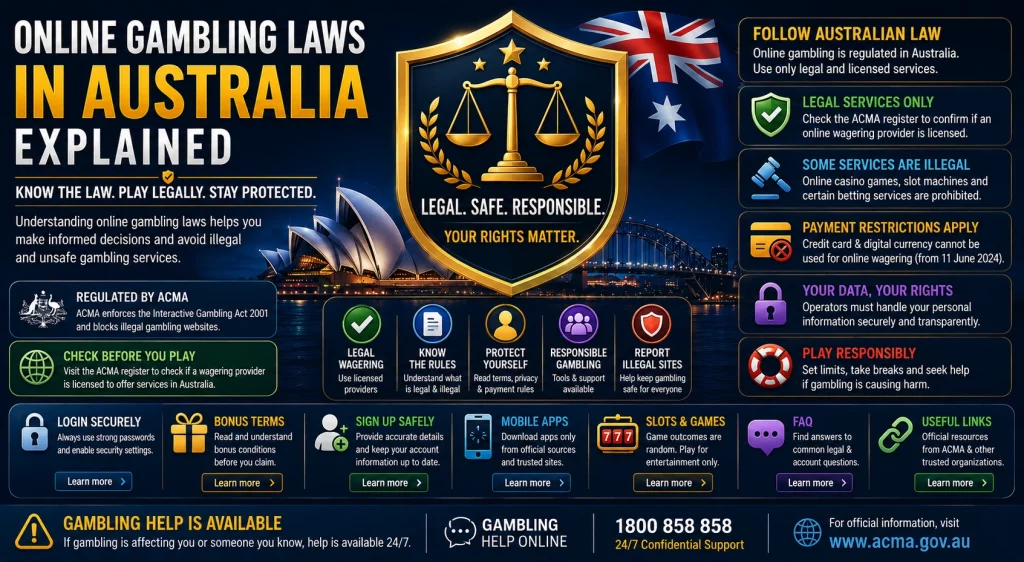
The main federal law governing online gambling services is the Interactive Gambling Act 2001. ACMA explains that this law makes it illegal for gambling providers to offer some online services to people in Australia, including certain banned interactive gambling services. ACMA also advises users to check whether an online wagering service is on the register of licensed interactive wagering providers before using it.
For a page titled “Online Gambling Laws in Australia Explained,” the purpose should be informational. It should not present gambling as risk-free, profitable, or automatically safe. A legal service can still involve financial risk, and an illegal service can create additional risks such as blocked withdrawals, identity misuse, weak complaint routes, and lack of consumer protection. The safest editorial approach is to explain how the law works, what readers should verify, and why official guidance matters.
Australian online gambling law also separates product categories. Online wagering services may be legal when properly licensed, but online casino-style services, online slot machines, scratchies, and certain other products can be prohibited when offered to people in Australia. This means readers should not ask only whether a platform has a licence somewhere. They should ask whether the exact product being offered is permitted for Australian users.
Why Online Gambling Legality Depends on Product Type
Product type is one of the most important parts of Australian online gambling law. A betting service, casino-style product, slot-style game, lottery-style product, or in-play betting feature may be treated differently. The legal question is not simply “Is this website available?” The real question is “Is this specific service lawful for Australian users?”
ACMA’s online gambling information directs people to use gambling services that are legal in Australia and to check whether a wagering service is on the register of licensed interactive wagering providers. ACMA also states that some illegal services can look legitimate while failing to provide the protections available under Australian law.
This is why visual trust signals should be treated carefully. A Login page may look secure, but it does not prove the operator is legal. A Bonus offer may look attractive, but it does not prove the service is permitted. A Sign up form may appear professional, but it does not prove that the website can lawfully accept Australian users. Legal checks should happen before any account activity, not after a payment, document upload, or withdrawal issue.
The same applies to mobile products. An App can feel official because it is convenient, but mobile access does not change the legal position of the underlying service. Users should be cautious with app downloads, mirror domains, private links, or social media promotions that do not clearly explain the legal operator and product availability.
Australian Online Gambling Law Reference
| Legal Topic | What It Means | Risk Signal | Official Resource |
|---|---|---|---|
| Interactive Gambling Act | The federal law that restricts certain online gambling services offered to people in Australia. | A website offers casino-style products to Australian users while giving no clear legal explanation. | ACMA: About the Interactive Gambling Act |
| Licensed wagering register | Online wagering services must be on the register of licensed interactive wagering providers to operate legally in Australia. | The operator cannot be matched to official Australian licensing information. | ACMA: Check if a gambling operator is legal |
| Illegal online services | Some online services, including casino-style games and online slot machines, are banned when offered to people in Australia. | The platform promotes **Slots** or casino-style **Games** without explaining Australian restrictions. | ACMA: Online gambling services |
| Blocked gambling websites | ACMA can request Australian internet service providers to block illegal gambling websites. | The platform uses mirror domains, changing links, or substitute URLs. | ACMA: Blocked gambling websites |
| Credit and digital currency ban | From 11 June 2024, online and telephone wagering operators cannot accept credit card or digital currency payments for bets. | The platform promotes restricted payment methods without explaining Australian payment rules. | ACMA: Credit ban |
What ACMA Does in Online Gambling Regulation
ACMA is the Australian Communications and Media Authority. It enforces key parts of the Interactive Gambling Act and publishes guidance about online gambling services, legal operator checks, blocked gambling websites, and payment restrictions. ACMA also investigates online gambling providers and can take action where providers offer prohibited or unlicensed services with an Australian customer link.
One important enforcement tool is website blocking. ACMA publishes information about blocked gambling websites and explains that the list includes illegal gambling websites subject to blocking action. For readers, this matters because a blocked or frequently changing gambling domain can indicate higher legal and consumer risk.
ACMA’s guidance also matters because illegal services may not offer the protections available under Australian law. This can affect withdrawal disputes, complaints, payment accountability, account restrictions, and user data protection. A website that looks functional is not automatically accountable.
A serious legality page should therefore direct readers toward official checks rather than relying on brand claims. The operator name, product type, licence status, payment rules, and complaint route should all be reviewed before the user trusts any gambling-related website.
How Australian Online Gambling Law Is Checked
Wagering, Casino-Style Games, and Restricted Products
Australian online gambling law can be confusing because different products are treated differently. Online wagering services may operate legally when properly licensed and registered. However, ACMA identifies banned services under the Interactive Gambling Act, including online casino-style games, online slot machines, scratchies, and in-play betting on sporting events.
For readers, this means the word “casino” needs careful handling. A website may call itself an entertainment platform, gaming hub, social casino, betting site, or interactive experience, but the product mechanics still matter. If users pay money, play chance-based games, or expect monetary outcomes, the legal analysis becomes more serious.
A strong FAQ should explain product restrictions clearly. It should answer whether the service is available to Australian users, which products are offered, what law applies, how payments work, and what support routes exist. If a website avoids these questions, the user should not treat it as legally transparent.
Official Links should also be visible in any serious legal discussion. ACMA guidance, blocked-site information, payment-rule updates, cyber safety advice, scam reporting, privacy information, and gambling help resources all support safer decision-making. A page that only promotes access without explaining restrictions is incomplete.
Payment Rules and the Credit Ban
Payment law is a major part of the online gambling framework. ACMA states that from 11 June 2024, users cannot use credit cards or digital currency to place bets, and online and telephone wagering operators are not allowed to accept payments using those methods.
This payment rule matters because it shows that online gambling law is not only about licences. It also concerns how gambling activity is funded and how financial harm is reduced. If a platform promotes restricted payment methods to Australian users, readers should treat that as a serious warning sign.
Payment transparency should include deposit methods, withdrawal rules, identity checks, fees, processing times, dispute handling, and rejected transaction procedures. A legal service should not make deposits clear while leaving withdrawals vague.
Users should also be cautious of private payment requests. No platform should ask for separate release fees, tax clearance payments, activation fees, or unofficial transfers to unlock gambling-related funds. These demands can indicate scam risk or weak accountability.
Responsible Gambling and Legal Protection
Online gambling law also connects with responsible gambling protections. A legal framework should not only define who may operate; it should also help reduce harm. Responsible gambling tools can include limits, time-outs, self-exclusion information, account closure options, support contacts, and marketing controls.
Gambling Help Online provides support for people affected by gambling across Australia. This type of independent resource matters because legal compliance does not remove the possibility of gambling harm. Users may still experience financial stress, chasing losses, secrecy, emotional pressure, or difficulty stopping.
State and Territory Gambling Regulation
Australian online gambling law is shaped by both federal rules and state or territory regulation. The federal Interactive Gambling Act focuses on online and interactive gambling services offered to people in Australia, while state and territory authorities regulate many land-based and locally licensed gambling activities. This creates a layered legal environment.
For readers, the important point is that a website’s legality cannot be judged by one phrase. A platform may mention a foreign licence, a state licence, a wagering licence, or a general gaming authorisation, but users still need to understand what that permission actually covers. A licence for one activity does not automatically authorise every online product.
State and territory rules may affect licensing, advertising, consumer protection, responsible gambling obligations, complaints, venue gambling, lotteries, and wagering operations. Federal rules may restrict whether certain interactive gambling services can be offered online to people in Australia. This means the legal picture depends on the operator, product, location, licence type, and delivery method.
A serious legal review should therefore separate general brand claims from specific legal permission. If a website says it is “licensed and regulated”, readers should ask: licensed where, by whom, for which products, and for which users? If the answer is unclear, the claim is incomplete.
Federal and Local Gambling Law Responsibilities
| Legal Layer | What It Usually Covers | What Readers Should Check | Risk Signal |
|---|---|---|---|
| Federal online gambling law | Restrictions on certain interactive gambling services offered to people in Australia. | Whether the product type is permitted online for Australian users. | The site offers casino-style online products without explaining Australian restrictions. |
| Licensed wagering regulation | Authorisation for certain betting or wagering services under relevant licensing frameworks. | Whether the operator appears on an official register and whether the licence matches the service. | The website claims to be licensed but gives no operator match or licence number. |
| State and territory oversight | Local gambling regulation, venue gambling, licensing, harm-minimisation rules, and complaints in specific contexts. | Whether the platform explains which local rules or restrictions apply. | The terms avoid location-specific information while targeting Australian users. |
| Payment regulation and restrictions | Rules around how gambling-related payments may be made or restricted. | Whether payment methods, limits, withdrawal processes, and restrictions are clearly explained. | The platform promotes restricted or unclear payment methods. |
| Responsible gambling duties | Harm-prevention tools, support visibility, exclusion systems, limits, and safer gambling information. | Whether practical tools are visible before account activity. | Responsible gambling information is hidden, generic, or weaker than promotional content. |
Why Offshore Operators Create Legal Confusion
Many online gambling websites are operated outside Australia. Some offshore platforms may display licence claims from other jurisdictions, use international payment providers, host games through third-party software, and publish terms under foreign law. This can make the website look regulated while still leaving Australian users with limited protection.
An offshore licence is not automatically fake, but it is not automatically enough. The key question is whether the service may lawfully be offered to people in Australia. A platform can be licensed somewhere else and still be restricted, unsuitable, or unlawful for Australian users depending on the product and market access.
Offshore operators can also create practical problems. If a payment is delayed, if an account is restricted, if identity documents are requested, or if a withdrawal dispute occurs, the user may need to deal with foreign support teams, foreign legal terms, and complaint routes that are difficult to use from Australia. This is one reason ACMA advises people to use gambling services that are legal in Australia.
Readers should be cautious when offshore platforms use broad language such as “international licence”, “global gaming approval”, “worldwide access”, or “licensed gaming entertainment”. These phrases may sound reassuring, but they do not answer the practical legal question. A stronger platform names the operator, licence authority, licence number, product scope, restricted countries, payment rules, and complaint route.
Product Restrictions and Casino-Style Games
Product restrictions are central to Australian online gambling law. Some users may assume that if a website is accessible, the products on it are permitted. That assumption is unsafe. Online availability does not prove legality. A site can be reached from Australia while offering products that are restricted or prohibited.
Casino-style games require particular caution. These products may include digital table games, online slot-style games, scratch-style products, live casino-style streams, or other chance-based gambling formats. A platform may use entertainment language, but the legal assessment depends on how the product functions and whether it is offered to people in Australia.
Readers should not rely on game images or provider names as legality signals. A familiar interface does not prove that the operator is allowed to offer that product locally. Product legality must be checked through official guidance, terms, operator information, and product restrictions.
If a platform avoids explaining why certain products are available to Australian users, that is a warning sign. A legal service should not make users guess whether the products they see are allowed.
Advertising and Bonus Rules
Advertising is another area where online gambling law matters. Promotional content can influence users before they understand the legal or financial risks. A gambling-related website should not present gambling as guaranteed income, investment, debt recovery, or a risk-free activity.
A bonus offer should be read as a legal and financial document, not just a promotion. Users should check eligibility, wagering requirements, expiry rules, maximum withdrawal limits, restricted products, payment restrictions, identity verification requirements, and cancellation rules. If the headline offer is clear but the conditions are hard to find, the promotion is not transparent.
Promotional language should also avoid pressure. Countdown timers, “last chance” messages, repeated pop-ups, and claims of guaranteed outcomes can encourage rushed decisions. A responsible legal environment should help users slow down, not push them toward immediate activity.
Readers should also check whether advertising includes responsible gambling context. Age restrictions, risk warnings, limits, self-exclusion, and support resources should be visible. If promotional content is much more prominent than harm-prevention information, the site’s legal culture is weak.
Account Registration and Age Verification
Account registration is a legal checkpoint because gambling services must restrict access by age and eligibility. A platform should make age requirements clear and should not design content that appeals to minors. It should also explain identity verification, account restrictions, responsible gambling tools, and market limitations before account creation.
A safer registration process gives users information before asking for sensitive data. It should explain why the platform collects personal details, how verification works, and what restrictions apply. If the sign-up flow is fast but legal information is missing, users should pause.
Age verification should be more than a decorative checkbox. A serious platform should have processes that support age and identity checks where required. It should also explain how documents are handled if verification is needed. A platform that asks for documents without privacy explanation is not legally transparent enough.
Users should never upload identity documents to an unclear operator. Legal status, operator identity, privacy policy, and secure upload channels should all be checked first. Once documents are exposed, the risk can continue beyond the gambling website.
Payment Methods and Legal Risk
Payment methods reveal a lot about legal and operational quality. A serious platform should explain which payment methods are allowed, which are restricted, how deposits and withdrawals work, whether fees apply, and how disputes are handled. Payment rules should be available before any transaction.
A major warning sign is a platform that makes deposits easy and withdrawals unclear. This imbalance can indicate poor transparency, unfair terms, or scam-like behaviour. Users should not need to deposit money before learning how withdrawals are reviewed, delayed, approved, or rejected.
Readers should also be cautious if support asks for payment outside the official platform. Requests for release fees, tax clearance, activation charges, private-wallet transfers, or payments to unrelated accounts should be treated as serious red flags. Legal gambling services should not require private payments to unlock balances.
The credit and digital currency restrictions for online wagering in Australia also show that payment methods are part of legal protection. Payment legality is not a secondary issue; it directly affects financial harm and consumer safety.
Complaint Handling and Dispute Resolution
A legal gambling-related platform should explain how complaints are handled. This includes payment disputes, account closures, verification disagreements, bonus disputes, privacy requests, and responsible gambling concerns. A website that says only “contact support” without a formal process is not providing enough accountability.
A strong complaint route includes written communication, ticket numbers, review timeframes, escalation options, and references to published terms. Users should be able to keep records. If support avoids written confirmation or moves the conversation to private messaging apps, the risk increases.
Complaint handling is especially important with offshore or unclear operators. If there is no practical route to escalate disputes, users may have little leverage when problems occur. This is why legal review should include not only whether a platform claims a licence, but also whether users can realistically complain.
A responsible legal page should encourage readers to preserve evidence. Screenshots of terms, payment rules, account messages, support chats, licence claims, and domain names can help if a platform changes information later.
How Legal Rules Connect with Safer Gambling
Online gambling law is not only about operator permission. It is also connected with harm reduction. Legal frameworks often include restrictions, responsible gambling obligations, advertising standards, and payment controls because gambling can cause financial and emotional harm.
A platform that takes legality seriously should make safer gambling tools easy to access. Limits, time-outs, self-exclusion, account closure, and independent support resources should be visible before problems develop. If these tools are hidden or difficult to use, the platform’s safety standard is weaker.
Users should also understand that legal access does not remove gambling risk. A service can be legal and still involve loss. Responsible gambling tools are needed because gambling can become harmful even when the platform is transparent.
A useful legal guide should therefore avoid promotional certainty. It should explain what the law restricts, what users should verify, and how to respond when risk appears. The practical message is to check legality, understand restrictions, protect data, and seek support early if gambling feels difficult to control.
Privacy, Data Protection, and Online Gambling Law
Online gambling laws in Australia should be understood together with privacy and data protection risks. A gambling-related website may collect more than basic account information. It may process names, dates of birth, residential addresses, email addresses, phone numbers, payment records, account activity, device information, support messages, marketing preferences, and identity verification documents. If the operator is unclear or illegal, this information may be difficult to protect or recover.
A legally responsible platform should explain its privacy practices before account creation. The privacy policy should identify the company responsible for data handling, describe what information is collected, explain why the information is needed, state how it may be shared, and describe how long sensitive files may be retained. A vague privacy policy is not only a customer-service weakness; it is also a legal and operational warning sign.
Identity documents require special caution. Some gambling-related services may ask for proof of age, address, identity, or payment ownership. Verification can be legitimate in regulated contexts, but users should not upload passports, driving licences, bank statements, or payment screenshots unless the operator, legal status, privacy policy, and upload channel are clear. A website that asks for documents through email, live chat, private messages, or unknown file-upload links should be treated as unsafe.
Privacy also connects with marketing. Gambling promotions can be sensitive because repeated offers may increase pressure on users who are trying to reduce or stop gambling. A responsible platform should explain how users can control emails, SMS messages, push notifications, and personalised offers. If marketing settings are hidden or ignored, the platform’s compliance culture is weak.
Privacy and Legal Compliance
| Compliance Area | What a Responsible Platform Explains | Risk Signal | Reader Action |
|---|---|---|---|
| Data controller or responsible company | The privacy policy clearly identifies the company responsible for collecting and using personal information. | The privacy policy does not match the operator named in the terms or uses vague wording such as “our partners”. | Compare the footer, terms, privacy policy, and support information before sharing data. |
| Identity verification | The platform explains when documents may be required, which files may be accepted, and how review works. | Documents are requested suddenly through chat, email, social media, or private messaging apps. | Do not upload identity files unless the operator and secure process are clear. |
| Payment information | The site explains how payment data is processed, protected, and shared with payment providers. | The platform asks for full card images, full banking screenshots, or unnecessary financial details. | Use only official secure payment forms and avoid sending financial screenshots casually. |
| Marketing preferences | Users can manage promotional emails, SMS messages, push notifications, and personalised contact. | Promotional contact continues after opt-out requests or after responsible gambling restrictions. | Avoid platforms that make promotional control difficult. |
| Data retention | The policy explains how long account records, payment records, and verification files may be kept. | The site collects sensitive files but gives no practical retention or deletion information. | Treat unclear retention rules as a major privacy warning sign. |
Cybersecurity and Legal Responsibility
Cybersecurity is part of online gambling law in practice because weak security can expose users to fraud, identity misuse, account takeover, and payment loss. A platform that handles gambling-related payments and identity data should use secure connections, protected account access, strong password recovery, session controls, fraud monitoring, and safe document upload systems.
HTTPS is necessary, but it is not enough. A secure connection means that data is encrypted between the browser and the website, but it does not prove that the operator is legal or trustworthy. A scam website can also use HTTPS. Users should treat the browser lock icon as a basic technical signal, not as proof of lawful operation.
Account recovery deserves careful attention. If a platform allows email changes, phone-number changes, payment-method updates, or withdrawal changes without meaningful verification, account takeover risk increases. A legally mature platform should protect sensitive account actions with additional checks.
Users should also be cautious with gambling-related messages that ask them to click a login link, verify an account, claim a reward, or update payment information. These messages may be phishing attempts. Legal services should not rely on urgent messages that push users to enter credentials through unknown links.
Advertising Rules, Inducements, and User Pressure
Online gambling law is closely connected with advertising standards. Promotional language can influence user decisions before they understand legal status, product restrictions, payment conditions, or gambling risk. A responsible platform should not use advertising that presents gambling as guaranteed income, a financial strategy, a debt solution, or a low-risk way to make money.
Promotional pressure can also appear through countdown timers, “last chance” banners, exclusive links, personalised offers, and repeated reminders. These tactics may encourage users to act quickly instead of reading terms. In a legally stronger environment, advertising should help users understand conditions clearly rather than push immediate activity.
Bonus terms should be readable before the user accepts anything. Important terms include eligibility, expiry, wagering requirements, maximum payout limits, restricted games, restricted payment methods, verification requirements, and cancellation rules. If a website makes the reward visible but hides the conditions, the advertising is not balanced.
Responsible gambling messages should be visible near promotional content. Age restrictions, risk information, limits, time-outs, self-exclusion, and support resources should not be buried. A platform that makes offers large and protective tools small is not presenting risk responsibly.
Online Gambling Law Risk Points
Website Blocking and Illegal Operator Risk
Website blocking is an important part of Australia’s online gambling enforcement environment. When illegal gambling websites are identified, ACMA can request Australian internet service providers to block access. For readers, this means that a gambling-related website using changing domains, mirror links, or substitute URLs should be treated carefully.
A blocked domain does not only create access inconvenience. It can signal that the operator has been associated with illegal online gambling activity. If a site asks users to move to a new domain after a block, the user should not assume the new address is safe. Domain switching can reduce accountability and increase phishing risk.
Mirror sites are also a problem because they make it harder to know which version is official. A user may arrive through an advertisement, affiliate page, SMS link, or private message and believe they are using the main platform. In reality, they may be entering details into a copied or unsafe page.
A responsible legal page should therefore teach readers to verify domains, avoid suspicious redirects, and avoid logging in through urgent messages. Stable, transparent access is part of legal and operational trust.
What Legal Operators Should Explain About Withdrawals
Withdrawal rules are a practical test of legal quality. A platform that handles money should explain how users can request withdrawals, what limits apply, how long review may take, which verification steps may be required, what fees may apply, and how disputes are handled. This information should be available before payment.
A risky platform may make deposits easy but withdrawals difficult. It may introduce new requirements after the user requests funds. It may ask for repeated documents, add unexpected fees, or claim that promotional terms prevent withdrawal. These patterns can create serious consumer risk.
A legal service should not require extra private payments to release funds. Requests for release fees, activation fees, tax clearance, VIP unlocking, or private-wallet payments should be treated as major warning signs. A legitimate process should be documented through official account channels and published terms.
Users should keep records of payment and withdrawal information. Screenshots of terms, transaction histories, support messages, and payment requests can be useful if a dispute needs to be reported.
How Online Gambling Law Protects Users and Where It Does Not
Online gambling law can improve user protection by defining which services may operate, restricting certain products, setting payment rules, supporting enforcement action, and encouraging responsible gambling controls. However, law does not remove every risk. Users still need to read terms, protect accounts, control spending, and avoid unsafe platforms.
Legal status does not guarantee winnings. It does not make gambling a financial strategy. It does not prevent losses. It does not mean every promotional term is favourable. It simply provides a stronger accountability framework than illegal, unclear, or anonymous services.
Illegal or unclear platforms create additional risk because users may have fewer complaint options. Payments may be harder to dispute. Data may be harder to protect. Support may be difficult to hold accountable. Terms may change or disappear. Domains may move.
This is why the practical legal standard is conservative: if a platform cannot clearly explain its operator, product legality, payment rules, privacy process, and complaint route, users should stop before sharing money or documents.
How Readers Should Use This Legal Information
Readers should use online gambling law information as a checklist, not as permission to gamble. The goal is to identify risk before account activity. The first step is to confirm whether the operator and product type are legal for Australian users. The second step is to read payment and withdrawal rules. The third step is to review privacy and document-handling practices. The fourth step is to check responsible gambling tools.
Users should avoid acting on urgency. Legal review takes time. A website that pressures users to register, deposit, claim a promotion, install an app, or upload documents before reading terms should be treated cautiously.
Readers should also avoid relying on one signal. A licence badge alone is not enough. A fast website is not enough. A long terms page is not enough. A familiar game image is not enough. Stronger confidence comes from several consistent signals: legal operator, permitted product type, transparent terms, secure payments, privacy clarity, responsible gambling tools, and accountable support.
The safest decision is to stop when the legal position is unclear. No promotion, game feature, or support reassurance should override legal uncertainty.
Final Checklist for Understanding Online Gambling Laws in Australia
Online gambling laws in Australia should be understood as a protection framework, not as a simple permission label. The law helps define which services may be offered, which products are restricted, how operators should be checked, how payment rules work, and why users should avoid illegal or unclear platforms. However, legal information must still be applied carefully. A website being accessible from Australia does not automatically mean that it is legal, safe, or accountable.
The safest starting point is always operator verification. Readers should identify the company behind the website, compare the operator name across the footer, terms, privacy policy, and payment rules, and check whether the service can be matched to official Australian information where relevant. If a platform avoids naming the legal operator or gives different company details across different pages, that is a serious warning sign.
The second major check is product type. Online gambling law does not treat every product in the same way. Wagering, casino-style games, online slot machines, scratch-style products, lotteries, and in-play betting can fall into different legal categories. A website may group products together under one entertainment label, but users should look at how each product actually works and whether it is permitted for Australian users.
The third major check is user protection. A legally stronger platform should explain payment rules, withdrawal limits, verification processes, privacy practices, responsible gambling tools, complaint routes, and support channels before users take action. If these details are missing, hidden, or inconsistent, the legal risk increases.
Final Australian Online Gambling Law Scorecard
| Final Legal Check | What a Stronger Platform Explains | Warning Sign | Recommended Reader Action |
|---|---|---|---|
| Operator identity | The legal company name, jurisdiction, licence information, and support details are consistent across the website. | The site hides ownership, uses only a brand name, or gives different company names on different pages. | Do not trust the platform until the responsible operator is clear. |
| Product legality | The site explains which gambling products are offered and whether those products are available lawfully to Australian users. | Casino-style games, slot-style products, or scratch-style products are promoted without clear Australian-facing restrictions. | Check the product type before registration, payment, or document upload. |
| Licence or register status | The platform provides specific, verifiable operator information that can be checked against relevant official sources. | The website shows a badge, seal, or offshore phrase without a traceable licence or operator match. | Treat decorative licence claims as weak evidence unless independently verified. |
| Payment rules | Deposits, withdrawals, fees, limits, processing times, payment restrictions, and disputes are explained before any transaction. | Deposits are easy to understand, but withdrawals are vague, delayed, or linked to surprise conditions. | Do not send money where withdrawal terms are incomplete. |
| Privacy and verification | The platform explains identity checks, document upload channels, data retention, third-party sharing, and privacy contact routes. | Support asks for passports, licences, bank statements, or payment screenshots through email, chat, or private messages. | Do not upload documents until the operator and privacy process are clear. |
| Advertising and offers | Promotional conditions are visible, realistic, and supported by clear terms near the offer. | The platform uses guaranteed-win language, countdown pressure, hidden restrictions, or unrealistic rewards. | Read offer terms as legal and financial conditions, not as simple marketing text. |
| Responsible gambling | Limits, time-outs, self-exclusion, account closure, support contacts, and marketing controls are easy to find. | Protective tools are hidden, vague, or much less visible than promotional content. | Use safer gambling tools early and avoid platforms that make stopping difficult. |
| Complaint handling | The platform explains how complaints are submitted, recorded, reviewed, and escalated. | Support gives vague reassurance but no formal dispute pathway. | Keep records and avoid platforms that cannot explain complaint handling. |
How to Read Legal Claims on Gambling Websites
Legal claims on gambling websites should be read slowly and critically. A statement such as “licensed and regulated” has limited value unless it identifies who is licensed, which regulator issued the permission, which products are covered, whether the licence is current, and whether Australian users are included or restricted. Broad language may sound reassuring, but it can leave the important legal questions unanswered.
A stronger legal claim is specific. It names the operator, jurisdiction, licence number, regulator, product scope, restricted markets, and complaint route. It also appears consistently across the website. If the licence statement appears only in the footer, while the terms and privacy policy say something different, the claim should not be treated as reliable.
A weak legal claim often relies on visuals. It may use a gold badge, certificate image, regulator-style icon, or trust seal without a working verification route. These elements may look official, but they are not proof. A user should be able to verify the claim outside the gambling website itself.
The same principle applies to foreign licences. A licence from another jurisdiction may be real, but it does not automatically mean the service is lawful for Australian users. The user still needs to check product type, target market, local restrictions, payment rules, and complaint access. Offshore wording should never be accepted as a substitute for clear Australian-facing legal information.
Why Legal Access Is Not the Same as Website Access
One of the most important ideas for readers is that website access does not prove legal access. A gambling-related website may load in Australia, accept visitors, display Australian-facing content, or appear in search results. None of that proves that the service is legally allowed to target Australian users.
This distinction matters because illegal or restricted platforms may still appear online. They may use mirror domains, social media links, affiliate pages, search ads, copied branding, or private invitations. Some may look more polished than smaller legal services. Appearance and availability are not reliable legal tests.
Readers should treat redirects and changing domains cautiously. If a platform repeatedly tells users to use a new link, updated mirror, backup domain, or private access page, the risk increases. A legitimate and accountable service should make official access routes stable and clear.
The safest interpretation is conservative: if legal access is not clearly explained, do not rely on technical access. Being able to open a page is not the same as having legal protection.
How Online Gambling Laws Affect Payments
Online gambling laws affect how payments may be handled, which methods may be restricted, and how operators should explain financial processes. Payment rules are important because gambling-related harm often becomes serious when users lose track of spending, use risky funding methods, or face unclear withdrawal conditions.
A responsible platform should explain payment rules before users share money. This includes deposit methods, withdrawal methods, minimum and maximum amounts, fees, processing times, verification checks, account-name matching, rejected payments, and dispute steps. These details help users understand financial exposure before taking any action.
A risky platform often makes deposits fast and withdrawals slow. It may show deposit options prominently while hiding withdrawal limits in difficult terms. It may introduce new verification demands after a withdrawal request. It may ask users to send extra money to release funds. These patterns should be treated as serious warning signs.
Payment legality also connects with harm prevention. Restrictions on certain payment methods exist because gambling funded through high-risk payment routes can increase financial harm. A legal guide should therefore present payment rules as user-protection information, not as a list of ways to fund gambling activity.
How Online Gambling Laws Affect Data and Identity
Legal compliance also affects how user data should be handled. Online gambling-related websites may process sensitive information, including identity documents, payment records, device data, address details, and gambling activity. If a platform is illegal, unclear, or poorly governed, users may have limited control over what happens to that data.
A responsible website should explain identity verification before requesting documents. It should tell users why documents may be needed, which types may be accepted, how they should be uploaded, who may review them, how long they may be kept, and how users can contact the privacy team. If these details are missing, readers should not upload sensitive files.
A weak platform may request documents only after a user tries to withdraw money. It may keep asking for more files without explaining why. It may ask for full bank screenshots, full card images, or unnecessary identity details. These practices increase privacy risk.
Users should treat identity documents as high-value personal data. Sharing them with an unclear operator can create risk beyond the gambling website, including impersonation, account misuse, financial fraud, and follow-up scams.
How Responsible Gambling Fits into Australian Legal Discussion
Responsible gambling is not separate from legal discussion. It is one of the practical ways a platform shows whether it takes user protection seriously. Online gambling can create financial and emotional harm, especially when users chase losses, borrow money, hide activity, or feel unable to stop.
A stronger platform should provide clear access to safer gambling tools. These may include deposit limits, loss limits, session reminders, time-outs, self-exclusion, account closure, and marketing controls. These tools should be easy to find before gambling activity escalates.
Responsible gambling information should also be specific. A general phrase such as “gamble responsibly” is not enough. Users need instructions, timeframes, contacts, and consequences. They should know how to set limits, how to take a break, how to close an account, and how to access independent support.
A platform that promotes gambling more clearly than it explains stopping is not balanced. Legal maturity should include friction that helps users slow down, not only features that keep them active.
What to Do If a Platform Appears Legally Unclear
If a gambling-related website appears legally unclear, the safest response is to stop before account activity. Do not register, deposit, upload documents, install an app, accept a promotion, or follow support instructions through private channels. Legal uncertainty should be resolved before risk exposure, not after.
Readers should then compare the platform’s claims. The operator name should match across the footer, terms, privacy policy, and payment rules. The product category should match legal guidance. The payment rules should be visible before deposits. The privacy policy should explain document handling. The responsible gambling section should include practical tools. The complaint route should be more than a generic support form.
If the platform remains unclear after these checks, readers should treat that uncertainty as a result. A trustworthy platform should become clearer when reviewed. A risky one usually becomes more confusing.
If money, documents, or login details were already shared with an unclear platform, readers should act quickly. They should secure passwords, protect the connected email account, contact the payment provider if needed, preserve evidence, and monitor for identity misuse. If gambling has become difficult to control, independent support should be used early.
Online Gambling Laws in Australia Explained
Online gambling laws in Australia are designed to control which services may be offered, restrict certain online gambling products, support enforcement against illegal operators, regulate payment risks, and protect users from harm. The key lesson for readers is that legality depends on operator identity, product type, market access, licensing status, payment rules, privacy practices, and responsible gambling controls.
Leon Casino should not be judged by appearance alone. Professional design, payment logos, casino-style graphics, large offers, or long terms pages do not prove legal status. Legal confidence comes from verifiable operator information, official checks, clear product restrictions, transparent payments, accountable support, and practical harm-prevention tools.
Readers should also understand the limits of legality. A legal or more transparent platform does not make gambling profitable, predictable, or risk-free. Gambling can still lead to financial stress and personal harm. Legal review reduces some risks, but it does not remove the need for limits, self-control tools, privacy caution, and support resources.
The safest rule is direct: verify before you trust. If a gambling-related website cannot clearly explain who operates it, what products it offers, whether those products are legal for Australian users, how payments work, how personal data is handled, and how complaints are resolved, the safer decision is to stop before sharing money, documents, or account details.






Comments